
Introduction
In the complex ecosystem of industrial manufacturing, power transmission is the pulse that keeps production lines alive. Whether it is a high-speed textile loom weaving thousands of meters of fabric or a massive stone crusher in a quarry, the ability to engage and disengage power efficiently is critical. At the center of this operation sits the Industrial Clutch Kit.
As we approach 2026, the demands on industrial clutches are shifting. The market is moving away from generic friction components toward smart, modular, and eco-compliant solutions. For distributors and wholesalers, understanding these technical evolutions is no longer optional—it is the key to retaining competitive advantage.
The Evolution of Industrial Clutch Kits: Defining High-Performance Standards for 2026
The industrial landscape is undergoing “Industry 4.0” transformation, and mechanical components are evolving to keep pace. The simple mechanical clutches of the past are being refined for higher efficiency and lower maintenance.
From Standard Friction to Advanced Composites: Material Innovation
Historically, asbestos and simple organic compounds were the norm. By 2026, the standard has shifted to High-Performance Non-Asbestos Organics (NAO) and advanced composites.
- Kevlar-Reinforced Facings: Offer 3x the wear life of standard organic materials and resist glazing under high-heat slip conditions.
- Sintered Bronze & Iron: Essential for mining and heavy industry, providing stable friction coefficients even at temperatures exceeding 400°C.
- Ceramic Composites: Used in high-shock applications, providing aggressive bite and zero-fade performance.
The Shift Towards Modular Design and Ease of Maintenance
Downtime is the most expensive line item in any factory. Modern industrial clutch kits are prioritizing modularity. “Split-element” designs allow maintenance teams to replace friction shoes or discs without dismantling the entire drive shaft. For distributors, stocking modular kits means you can service a wider range of machinery with fewer SKUs.
Supply Chain Resilience: What 2026 Buyers Need to Know
Global disruptions have taught the industry a hard lesson: reliability is as important as price. The 2026 procurement strategy focuses on “China+1” or partnering with manufacturers (like Kukauto) who have vertically integrated supply chains—controlling everything from the casting foundry to the final assembly—to mitigate raw material shortages.
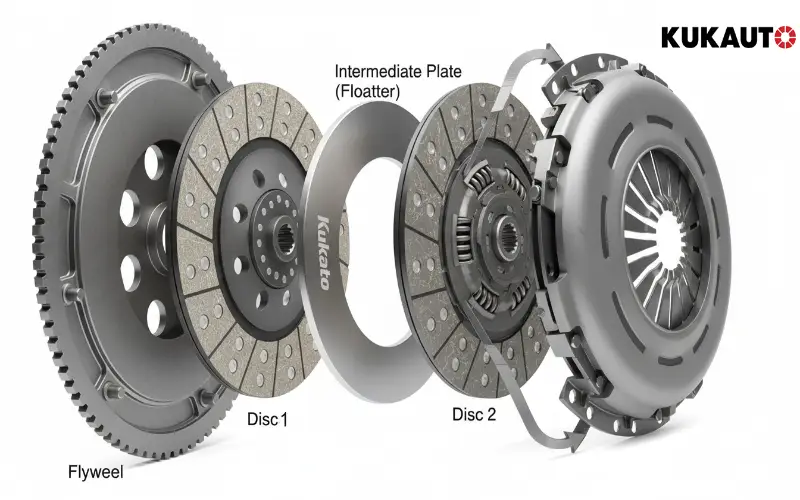
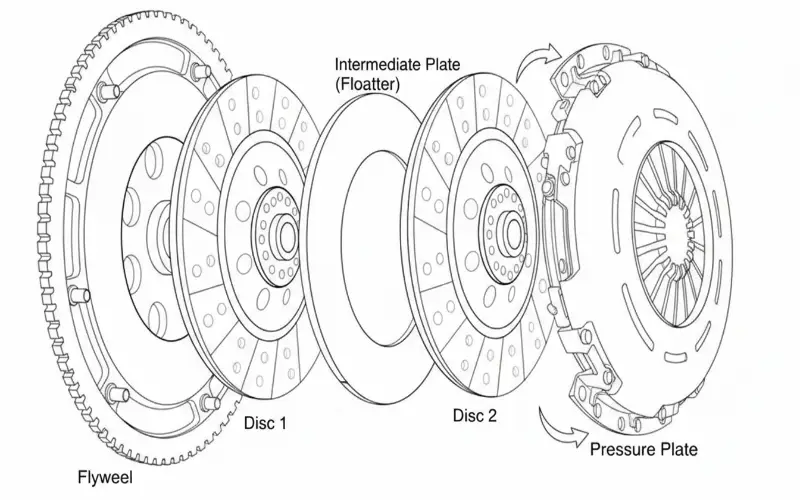
Anatomy of an Industrial Clutch Kit: Critical Components and Materials

Understanding the physics behind the components helps in diagnosing failures and selecting the right upgrades.
The Clutch Disc: Understanding Friction Coefficients and Wear Life
The disc is the sacrificial element. In industrial applications, the Friction Coefficient (µ) must match the torque requirement.
Low Friction (µ 0.25): For smooth engagement (Paper mills, wire drawing).
High Friction (µ 0.45+): For locking engagement without slip (Crushers, stamping presses).
Pressure Plate Dynamics: Clamping Force and Heat Management
The pressure plate acts as a heat sink. In continuous duty applications, the mass of the casting is critical. Thin, lightweight automotive-style plates will warp under the thermal load of industrial inching. Industrial plates often feature ventilated vanes to promote airflow and cooling.
Release and Pilot Bearings: The Unsung Heroes of Durability
Industrial cycles are frequent. A textile machine might engage/disengage 10 times a minute. Standard automotive bearings will seize. Industrial kits must include High-Temperature Sealed Bearings designed for high axial loads and resistant to dust ingress.
Alignment Tools: Ensuring Precision Installation
Misalignment is the leading cause of premature spline wear. Professional kits include precision-machined steel alignment tools (not plastic) to ensure the heavy industrial gearbox mates perfectly with the engine flywheel.
Classification Guide: Types of Industrial Clutches and Their Applications
Categorization by Operating Principle: Electromagnetic vs. Mechanical
The choice between electromagnetic and mechanical actuation defines the machine’s behavior. Below is a comparison to guide selection.
| Feature | Mechanical Clutch (Friction) | Electromagnetic Clutch |
|---|---|---|
| Actuation Method | Physical linkage, springs, or hydraulic pressure. | Magnetic field generated by an electric coil. |
| Torque Capacity | Extremely High. Ideal for heavy loads. | Moderate. Limited by coil size and magnetic saturation. |
| Maintenance | Low. Simple mechanical wear parts. | Medium. Requires brush checks and electrical diagnostics. |
| Best Use Case | Mining, Agriculture, Heavy Construction. | Packaging, HVAC, Office Automation. |
Critical Comparison: Dry vs. Wet (Oil-Bath) Clutches
In industrial settings, choosing the right environment is as important as choosing the right clutch.
| Environment | Dry Clutch | Wet Clutch (Oil Bath) |
|---|---|---|
| Heat Dissipation | Good (Air cooled). Limited in continuous slip applications. | Excellent. Oil carries heat away to a cooler. |
| Friction Coeff. | High (0.35 – 0.50). Strong “bite”. | Lower (0.05 – 0.10). Requires more plates to hold same torque. |
| Maintenance | Easy visual inspection; sensitive to dust/moisture. | Complex (Oil changes, filters); sealed from environment. |
| Ideal Application | General machinery, pumps, textile looms. | Marine gears, heavy winches, high-slip tensioners. |
Industry-Specific Solutions
Requirement: High-frequency engagement.
Solution: Low-inertia organic composites to prevent tearing delicate threads during startup.
Requirement: Smooth slip & heat management.
Solution: Large diameter multi-plate clutches with “slip capability” to slowly accelerate massive rollers.
Requirement: Shock load resistance.
Solution: Sintered Iron Buttons and reinforced damper springs to handle rock crushing loads.
Technical Selection Criteria: Sourcing the Right Specifications for Your Market
Calculating Torque Capacity and Safety Factors
Never size a clutch based solely on the motor’s horsepower. You must calculate the required torque:
Once base torque is known, apply a Service Factor (Safety Factor). For smooth loads (fans), use 1.5. For heavy shock loads (rock crushers), use 3.0 or higher.
Thermal Dissipation Requirements for Continuous Duty Cycles
If the machine requires frequent starting and stopping, the clutch generates heat. If the heat generation rate (Slip Energy) exceeds the clutch’s dissipation capacity, the facings will fade and burn. For high-cycle applications, ensure the pressure plate has adequate ventilation or consider a wet clutch system.
Bore Size, Keyways, and Mounting Compatibility
Industrial standards vary (SAE vs. DIN). Ensure you verify the spline count, input shaft diameter, and pilot bearing bore size. A mismatch of 1mm renders the kit useless.
Environment Factors: IP Ratings and Corrosion Resistance
For outdoor or wash-down environments (food processing), standard steel will rust. Look for clutch kits with Zinc-Nickel plating or phosphate coatings to resist corrosion.
Expert Installation & Run-in Guide
In industrial applications, 70% of clutch failures are traced back to poor installation, specifically misalignment.

1. Precision Alignment
- Dial Indicator Check: Measure the run-out of the flywheel face and the pilot bore. It must be within 0.005 inches (0.13mm).
- Soft Foot: Ensure the motor/engine feet are flat. A “soft foot” distorts the housing, causing internal misalignment.
- Laser Alignment: For large coupled shafts, laser alignment is mandatory to prevent vibration that destroys clutch hubs.
2. The “Bedding-in” Process
- The Goal: To mate the friction material to the metal surface for 100% contact area.
- Procedure: Perform 30-50 engagement cycles at 50% load or reduced speed.
- Warning: Skipping this step leads to “Green Fade” where new resins gas out rapidly, creating a lubricating layer that causes slippage.
2026 Market Insights: Trends Shaping the Distributor Landscape
The Rise of Smart Clutches and IoT Integration
High-end industrial clutches are beginning to feature embedded wear sensors. These connect to the factory’s IoT network, alerting maintenance teams when the friction material thickness drops below a critical level, enabling Predictive Maintenance rather than reactive repairs.
Sustainability Regulations: Asbestos-Free and Eco-Friendly Materials
Strict regulations in the EU and North America strictly prohibit asbestos. However, new regulations are targeting copper and heavy metals in friction dust. Distributors must source “Eco-Friction” certified products to ensure future compliance.
Global Sourcing vs. Local Warehousing: Optimizing Inventory Strategy
The trend is hybrid. Distributors are holding “safety stock” of fast-moving items locally while relying on agile manufacturers (like Kukauto) for rapid production of specialized, low-volume heavy industrial clutches.
Procurement Strategy for Wholesalers and Distributors
“Don’t just buy the product; buy the consistency. A cheap clutch that varies in quality from batch to batch will destroy your reputation faster than a high price will.”
How to Audit Suppliers: ISO Certifications and Testing Reports
Demand transparency. A qualified supplier should provide IATF 16949 certificates and detailed lab reports showing friction coefficients at varying temperatures (Cold vs. Hot). Ask for “Link Test” results for heavy-duty applications.
Balancing Price vs. TCO (Total Cost of Ownership)
Educate your customers. A premium clutch kit might cost 20% more but last 50% longer. In industrial settings where downtime costs thousands per hour, TCO always wins over initial price.
Packaging and Private Labeling Opportunities
Kukauto supports private labeling. This allows distributors to build brand equity. Ensure the packaging is robust (wooden crates for heavy items) to prevent transit damage, which is a common issue with heavy industrial parts.
Managing After-Sales Support and Warranty Claims
Establish a clear warranty protocol. Industrial warranties usually cover hours of operation (e.g., 2,000 hours) rather than mileage. Partner with a manufacturer that offers technical analysis for failed parts to determine if the issue was product defect or operator error.
Maintenance, Troubleshooting, and Extending Service Life
Detailed Industrial Troubleshooting Matrix
| Symptom | Root Cause Analysis | Industrial Solution |
|---|---|---|
| Slippage Under Load | 1. Friction material worn. 2. Overloaded beyond safety factor. 3. Weak pressure springs. |
Check torque calc. Upgrade to High-Coefficient material (Ceramic). Replace springs. |
| Excessive Heat / Smoke | 1. Constant slipping (Inching). 2. Blocked cooling vents. |
Switch to Ventilated Pressure Plate. Increase cooling airflow. |
| Severe Vibration | 1. Misalignment between motor/gearbox. 2. Unbalanced clutch assembly. |
Perform Laser Alignment. Ensure dynamic balancing of the replacement kit. |
| Dragging (Won’t Disengage) | 1. Pilot bearing seized. 2. Splines rusted/dirty. |
Replace pilot bearing. Clean splines and use anti-seize (sparingly). |
Establishing a Preventive Maintenance Schedule
Schedule inspections every 500 hours. Check for linkage wear, pedal free-play, and dust accumulation. Blow out dust with compressed air to prevent abrasion.
Case Study: Solving High-Inertia Failure in a Paper Mill
The Challenge
A large paper mill in Brazil was experiencing clutch explosions on their main roller drives every 3 months. The massive inertia of the 5-ton paper rolls required a 30-second slip time to start, generating heat that warped standard pressure plates.
The Kukauto Solution
We engineered a custom “High-Mass Ventilated” Clutch Kit. It featured a pressure plate with 40% more iron mass (heat sink) and aggressive cooling vanes. We paired it with a segmented Sintered Bronze disc.
📈 Result: Service life extended from 3 months to 14 months. Annual maintenance savings: $120,000.
Frequently Asked Questions (FAQ) About Industrial Clutch Kits
Why Kukauto is the Best Industrial Clutch Kits Manufacturer?
In a market flooded with generic parts, Kukauto stands apart as a specialized manufacturer dedicated to heavy-duty performance.
Engineering Excellence
Our R&D center in Shandong can develop custom friction formulas tailored to your specific industrial environment, whether it’s the humidity of a paper mill or the heat of a steel foundry.
Strict Quality Control
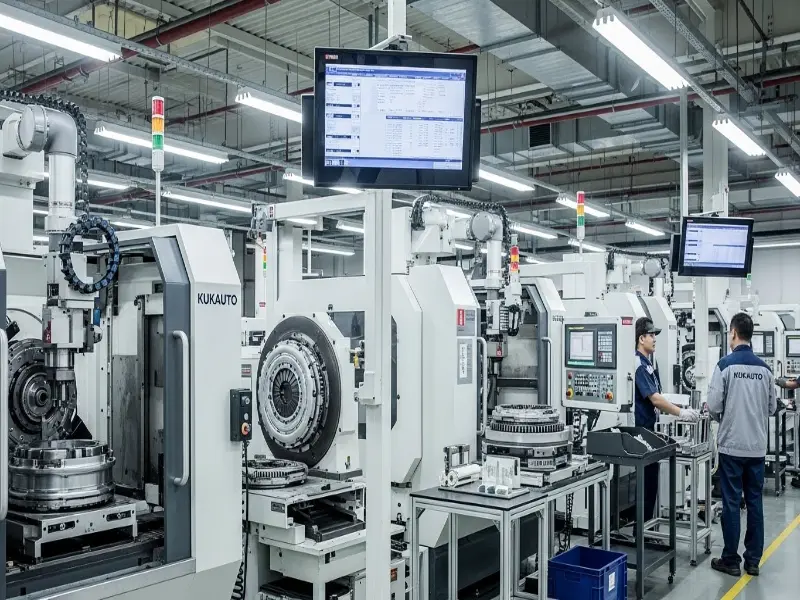
We don’t just meet standards; we exceed them. Our IATF 16949 certified facility ensures every batch is tested for torque holding capacity and burst speed safety.
Reliable Supply Chain
With a production capacity of 200,000 sets per year and vertically integrated manufacturing, we guarantee on-time delivery for global distributors, protecting you from supply chain shocks.
Comprehensive Support
From technical consulting on torque calculations to handling warranty claims, our dedicated support team acts as an extension of your business.
Secure Your Industrial Supply Chain
Don’t let component failure stop production. Partner with Kukauto for industrial clutch kits that combine durability, performance, and value. Request our 2026 Industrial Catalog today.
- ✓ Custom R&D Solutions
- ✓ High-Torque Sintered Options
- ✓ Global Shipping & Support
Ready to Upgrade Your Industrial Parts?
Contact our industrial application engineers today.
📧 Email: [email protected]
Response time: Within 24 hours