
Introduction: The “Tires” of Your Transmission System
Imagine putting bicycle tires on a Ferrari. No matter how powerful the engine is, without grip, you go nowhere. The friction lining (or facing) is to a clutch what tires are to a car: the sole point of contact that transmits power. Yet, it remains the most undervalued component in the supply chain.
The Cost of Failure
In the competitive world of auto parts distribution, saving $20 on a cheaper lining might seem like a smart margin play. But when that lining disintegrates after 10,000 km, the resulting warranty claim—towing, labor, and a replacement kit—can cost over $2,000 in downtime.
Material Science 101: What Goes Into a Premium Lining?
A friction lining is a complex composite material baked under extreme pressure. Its performance depends on the “Recipe.”
The Recipe
- Resins: The binder that holds everything together.
- Fiber Glass: Provides structural integrity and burst strength.
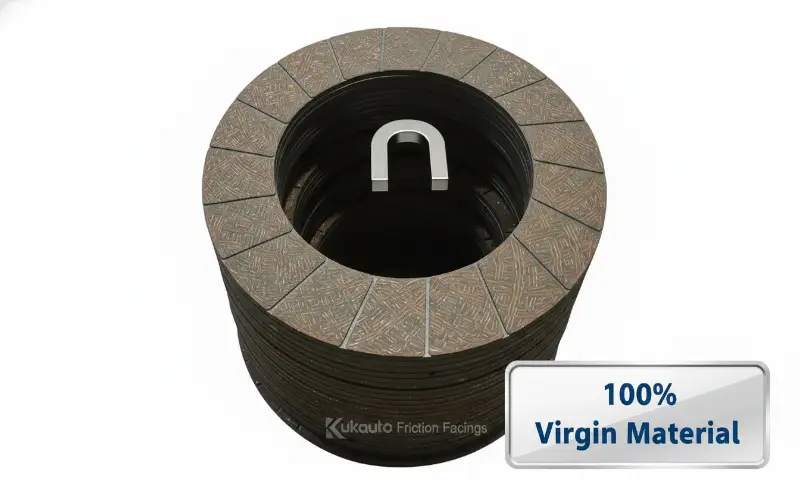
- Copper Wire: Conducts heat away from the friction surface.
- Friction Modifiers: Cashew nut shell oil, graphite, and other compounds to stabilize the coefficient.
The Role of Copper vs. Steel
Copper is expensive; steel is cheap. This leads to one of the most common cost-cutting tricks in the industry.
“Here is a simple test you can do in 5 seconds: Take a magnet and touch it to the friction lining. If it sticks, the manufacturer has used steel wool or iron filings instead of copper. Steel retains heat and acts like a grinder, destroying the flywheel. If it doesn’t stick and you see yellow flecks, it’s Copper/Brass—the hallmark of a premium lining that dissipates heat.”
Classification: Choosing the Right Material for the Job
| Material Type | Characteristics | Best Application |
|---|---|---|
| Organic (Woven/Molded) | Smooth engagement, quiet operation, moderate heat tolerance. | On-highway trucks, Passenger cars, Light commercial vehicles. |
| Cerametallic (Sintered) | Aggressive bite, extreme heat resistance (600°C+), “on/off” feel. | Agricultural Tractors, Mining Loaders, Racing. |
| Kevlar / Aramid | Long wear life, smooth engagement, very low abrasion on flywheel. | High-performance street cars, Heavy towing vehicles. |
Critical Performance Indicators (KPIs) for Friction Linings
Friction Coefficient (μ)
Stability is key. A good lining maintains a coefficient of 0.35-0.45 even when hot. Cheap linings suffer from “Heat Fade,” where the coefficient drops to 0.20 at high temperatures, causing slippage on steep hills.
Burst Strength (Rotational Speed)
Centrifugal force is a killer. At 8,000 RPM, a weak lining will explode inside the bell housing.
Trust Builder: Kukauto tests every batch on a high-speed spin tester to ensure the bonding integrity holds up to 200% of the maximum engine RPM.
Manufacturing Process: The Hidden Difference
Drilling & Riveting
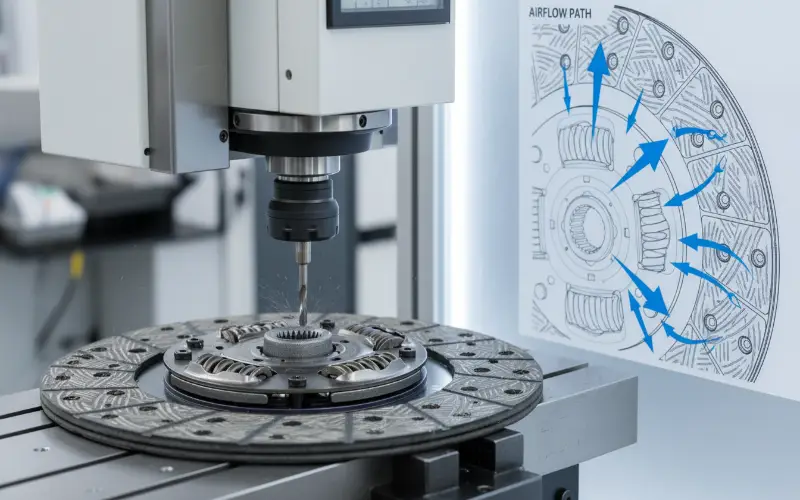
Precision drilling prevents micro-cracks around the rivet holes. Cheap factories punch these holes, weakening the structure.
Groove Design: More Than Just Looks
Many buyers think the patterns on the face are for decoration.
“The grooves (slots) are the lungs of the clutch. They have two vital functions: 1. Removing Dust: They channel wear particles out so they don’t act like ball bearings causing slip. 2. Cooling: They allow air to flow between the disc and pressure plate, lowering operating temperatures by up to 30°C.”
Common Failures & How to Identify Them

Caused by overheating. The resin boils to the surface and hardens like glass. Friction drops to near zero.
The lining explodes or chunks fall off. Caused by poor fiber bonding or over-revving the engine.
Dark, greasy appearance. Even the best lining fails if a rear main seal leaks oil onto it.
Sourcing Guide: Avoiding the “Recycled Waste” Trap
This is the dark side of the aftermarket. To cut costs, some factories grind up old tires, shoe soles, and industrial waste to use as “filler” in their friction mix.
The “Smell Test”
Density Check
Premium linings are dense and heavy due to copper and brass content. Cheap linings feel porous and light. If you can scratch the surface easily with a fingernail, it’s too soft for heavy-duty use.
FAQ: Friction Lining Questions
Conclusion & Kukauto’s Commitment
The friction lining is not a place to compromise. It determines whether a vehicle makes it to its destination or ends up on a tow truck.
Kukauto’s Standard
We adhere to strict raw material controls, utilizing Raybestos-equivalent formulas with high copper content and zero recycled waste. Our linings are tested to exceed OEM burst strength and wear life requirements.
Test the Quality Yourself
Don’t take our word for it. Request a sample of our High-Copper Friction Facing today. Put a magnet to it. Smell it. Feel the density.