
Introduction: The Great Auto Parts Debate
In the automotive supply chain, few topics spark as much debate as the “OEM vs. Aftermarket” question. For wholesalers and fleet managers, this isn’t just a technical choice; it’s a financial strategy. Understanding the nuance between a “Genuine” part and a “Premium Aftermarket” part can mean the difference between a 10% margin and a 40% margin.
Defining the Terms
- Genuine (OE): The part in the car manufacturer’s box (e.g., Volvo, Scania). Sold at dealerships.
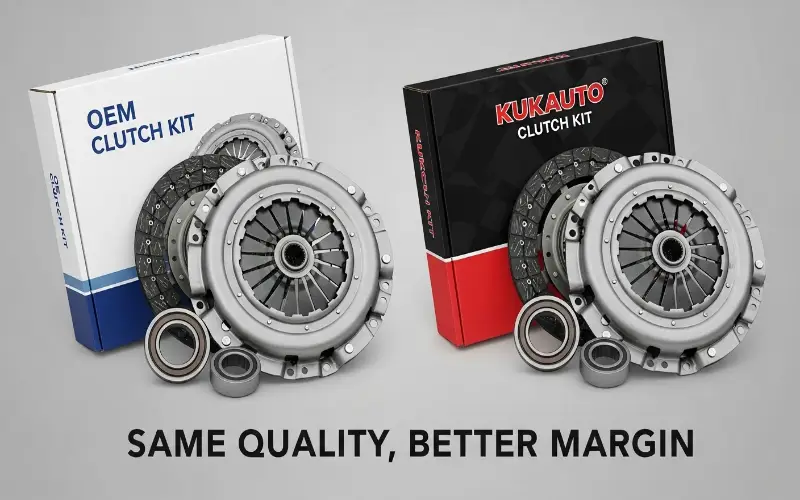
- OEM (Original Equipment Manufacturer): The company that made the part for the car manufacturer (e.g., Valeo, Sachs). Same part, different box.
- Aftermarket (IAM): Independent manufacturers producing replacement parts. This ranges from high-quality Tier 1 to low-quality budget options.
“Here is the truth car manufacturers don’t want you to know: They don’t make clutches. They assemble trucks. 80% of ‘Genuine’ parts are manufactured by suppliers like Valeo, Exedy, or specialized factories like Kukauto, then rebranded with a hefty ‘Logo Tax’. As a distributor, you are often paying triple the price just for the blue box.”
The Case for Original (OE) Clutches
There is a time and place for OE parts. They are the safe harbor for risk-averse buyers.
The Pros
- Guaranteed Fitment: Zero risk of installation issues.
- Warranty: Supported directly by the dealer network.
- Peace of Mind: Ideal for customers who demand “factory spec” regardless of cost.
The Cons
- The Branding Tax: You pay for the marketing, not just the metal.
- Low Margins: Dealership pricing structures leave little room for distributor profit.
- Availability: OE parts for older models (5+ years) are often discontinued (NLA).
The Aftermarket Spectrum: Not All “Non-Original” Are Equal

Grouping all aftermarket parts together is a mistake. The market is stratified.
Tier 3: Budget / Rebuilt (Avoid)
These are often “cleaned and painted” used parts or manufactured with recycled steel and inferior friction materials. They are cheap upfront but expensive in warranty claims.
Tier 1: Premium Aftermarket (Kukauto Level)
This is the “Sweet Spot.” Manufacturers in this tier operate under IATF 16949 standards—the same standards as OEMs. They use new steel, premium friction facings, and automated testing.
Technical Face-Off: OEM vs. Premium Aftermarket
Let’s strip away the branding and look at the engineering. How does a Kukauto clutch compare to the one in the dealer box?
| Component | OEM Standard | Kukauto Premium Aftermarket |
|---|---|---|
| Friction Material | Valeo / Raybestos | Sourced from same Tier 1 suppliers or equivalent formula. |
| Diaphragm Steel | 51CrV4 (German Standard) | 51CrV4 (Imported Grade) – Same fatigue life. |
| Damping Spring Life | 3,000,000 Cycles | > 2,800,000 Cycles (Verified by Fatigue Test). |
| Casting Grade | HT250 Grey Iron | HT250 Grey Iron (High Thermal Stability). |
The Economics: Why Distributors Are Switching to Aftermarket
Margin Analysis
Selling OE parts is a volume game with razor-thin margins (often 10-15%). Premium Aftermarket parts allow distributors to control their pricing strategy, often realizing margins of 30-40% while still offering a lower price to the end-user.
The “Second Owner” Market
Most heavy trucks are sold to a second owner after 5 years or 500,000 miles. These second owners are cost-conscious. They refuse to pay $1,500 for an OE clutch when a $700 aftermarket kit does the job perfectly. Catering to this segment requires a strong aftermarket partner.
FAQ: Dispelling the Myths
How to Verify Aftermarket Quality (Due Diligence)
Don’t take a factory’s word for it. Audit them using these criteria:

-
1.
Check for IATF 16949: This is the specific ISO standard for the automotive industry. General ISO 9001 is not enough for critical powertrain components.
-
2.
Ask for Raw Material Certificates: Request the mill certificates for the steel and the technical data sheet for the friction material.
-
3.
Inspect Testing Facilities: Do they have a Fatigue Testing Machine? Do they perform Drag Torque tests? A manufacturer without a lab is just an assembler.
Conclusion: Making the Smart Choice for Your Business
Summary Table
| Category | Cost | Quality | Margin Potential |
|---|---|---|---|
| OEM / Genuine | High ($$$) | 100% | Low (10-15%) |
| Kukauto Premium | Medium ($$) | 98% | High (30-45%) |
| Budget Brand | Low ($) | Variable (Risky) | Medium (High Returns) |
Stop Paying the “Logo Tax”
Build your brand with OEM-standard quality at aftermarket prices. Test Kukauto’s precision-engineered clutch samples today and see the fitment perfection for yourself.