Importing mining clutches involves much more than comparing FOB prices. A competitive factory quote is only one part of the total cost. Incorrect HS codes, unexpected import duties, freight charges, customs fees, and inland transportation can significantly increase your final landed cost. Understanding these expenses before placing an order helps buyers avoid budget overruns and make more profitable sourcing decisions. In this guide, we’ll explain how to calculate the landed cost of mining clutches, choose the correct HS code, and identify the hidden costs that many importers overlook.
Most buyers focus on unit price and FOB pricing negotiations. That’s the easy part. The real skill lies in pinning down the HS code before the shipment leaves the factory. A clutch kit classified as 8708.93 carries a different duty rate than one lumped under 8483 if the factory packs a flywheel in the same crate. Get that detail wrong, and the landed cost swings by three to five percent. The same logic applies to quality tolerance clauses. An OEM-level supplier will build to a friction coefficient range and a parallelism spec. A commodity supplier ships what’s convenient. The difference shows up in warranty claims, not in the quote.
The final detail most distributors skip? The Merchandise Processing Fee and Harbor Maintenance Fee. On a $50,000 order, those two line items add over $200. That’s not a rounding error. It’s the difference between a profitable quarter and a phone call to the accountant explaining why the margin leaked. Professionals build every landed cost line into the spreadsheet before the wire transfer goes out. Amateurs add it up after the container clears customs and the broker invoice arrives.
Essential HS Codes for Mining Clutch Kits
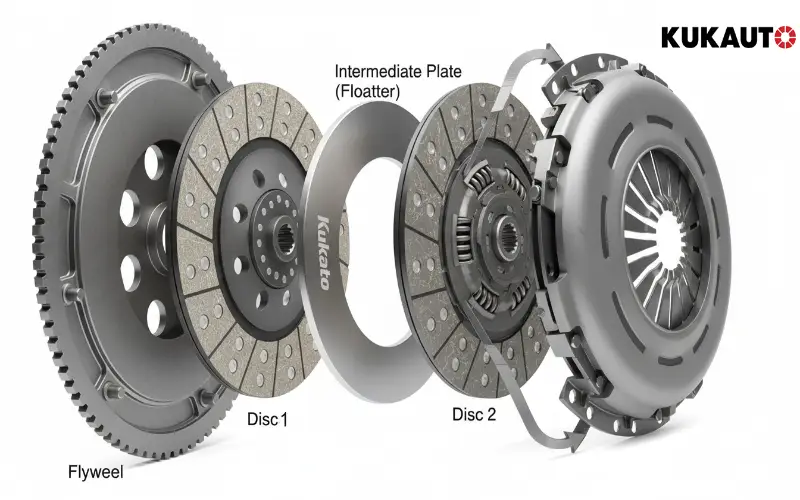
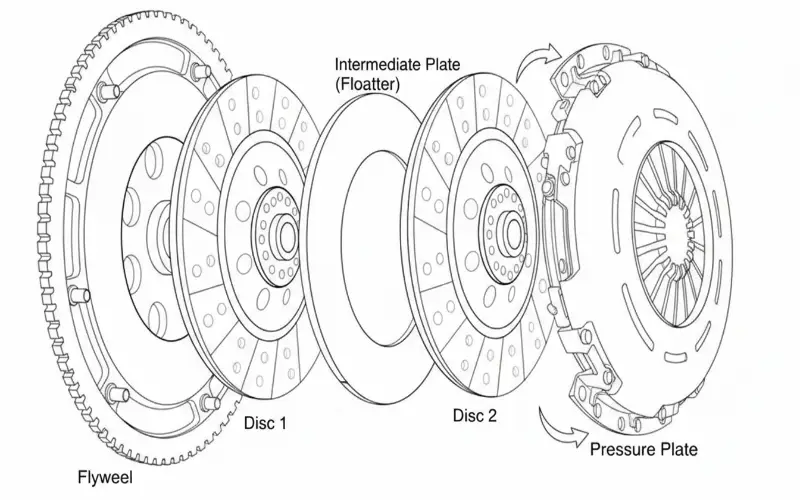
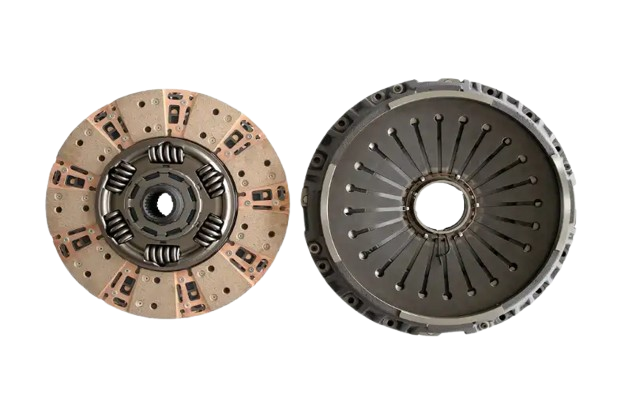
Clutch discs, covers, and release bearings fall under 8708.93—until you add a flywheel or pilot bearing.
You’re importing a pallet of mining truck clutch kits. You put down HS 8708.93 without thinking twice. But ask any customs broker what they see on Monday mornings: a stack of CF-28 notices for kits that contained a flywheel or pilot bearing but were declared as “clutch parts.” Misclassification is not a paperwork nuance. It’s the difference between paying 0% duty and getting slapped with a 2.5% ad valorem hit—plus a penalty—that can erase your margin on a $50,000 shipment. One distributor I worked with lost $4,700 on a single container because the pre-production sample clearly showed a full assembly with a pilot bearing, yet the commercial invoice stuck with 8708.93. Customs reclassified it on inspection based on a physical exam, and the FOB pricing the buyer had negotiated suddenly didn’t cover the new landed cost.
- What stays under 8708.93: Clutch disc, pressure plate (cover), and release bearing. These are parts of a motor vehicle clutch system, typically carrying low or zero duty in many jurisdictions, and are the foundation of most “clutch kit” invoices.
- What shifts the HS code: Add a flywheel (often classified under 8483.50 as a transmission shaft or flywheel), a pilot bearing, or a dual-mass flywheel assembly, and customs may reclassify the whole shipment. The kit stops being “clutch parts” and becomes a “clutch assembly” or even a “flywheel and clutch package”—triggering a different duty rate and complicating your ISF-10+2 filing.
- The quality tolerance trap: If your sample approval process shows a complete kit but your mass production order omits the flywheel to keep the code simple, a physical inspection can still flag inconsistencies between the shipping documents and the actual load. Always ensure the commercial invoice exactly matches the kit contents—especially when the supplier changes a part number mid-order.
Country-specific duty rates are not one-size-fits-all. The same “clutch kit” can land at 0% in one port and 5% in another, solely based on how a national tariff schedule interprets subheading 8708.93. The numbers below are starting points for three key mining equipment markets, but treat them as a benchmark to verify with your own licensed broker before cutting a purchase order.
- United States: HS 8708.93.60 (other motor vehicle clutch parts) carries a general duty of 2.5%. For tractor/truck applications, 8708.93.10 may apply at a different rate. Section 301 tariffs on Chinese auto parts can add up to 25% on top—check the USTR list for the latest exclusions. Many distributors miscalculate the mining truck clutch kit import duty US side by ignoring these extra layers.
- European Union: CN code 8708 93 90 90 (other parts) draws a 3.5% most-favored-nation tariff. The specific HS code 87089390 mining clutch parts that are solely for off-highway mining vehicles might sometimes shift into Chapter 84, attracting a lower rate, but this requires a binding tariff information ruling (BTI) from your local customs authority.
- Australia: Under the China-Australia Free Trade Agreement (ChAFTA), many mining clutch parts declared under 8708.93 qualify for 0% duty—provided you hold a valid certificate of origin for clutch imports. Without that certificate, the general 5% rate applies. A single missing document can add hundreds of dollars to a container, erasing the FOB price advantage.

Choosing the Right Incoterm for Heavy Cargo
FOB gives you control; CIF gives the supplier a reason to cut corners on freight.
A distributor once absorbed a $50,000 loss on a single container of mining clutch kits. The boxes arrived, but half the release bearings had seized—saltwater had crept through a barely sealed container. The supplier booked the cheapest carrier under CIF terms, and the marine insurance claimed partial loss based on depreciated value. The buyer had no recourse because he never owned the freight contract.
When a single palletized clutch assembly tips the scale at 200 kg or more, the choice between FOB and CIF isn’t academic. It determines who controls freight routing, insurance value, and the packing standard that protects your quality tolerance. With FOB pricing, you lock the factory-gate cost after sample approval, then appoint a forwarder who knows how to lash break-bulk cargo. The supplier ships to your forwarder’s consolidator, and you dictate the vessel and insurance terms.
- Control: FOB puts the freight contract in your name; CIF leaves it with the supplier, who typically selects the lowest bid.
- Cost transparency: FOB separates product cost from logistics; CIF bundles freight and insurance, often marking them up 15–20%.
- Insurance adequacy: Under FOB, you buy insurance for full replacement value plus freight. Under CIF, the supplier’s policy often covers only the commercial invoice value minus depreciation.
- Break-bulk handling: FOB lets you mandate crating and lashing that suits break-bulk vessels; CIF leaves packaging decisions to the factory, which may skimp to save freight weight.
Insurance requirements for palletized clutch kits go far beyond a basic marine cargo policy. If you’re shipping break-bulk, you need an Institute Cargo Clauses (A) policy—all-risk coverage that includes damage from rough handling, hook damage, and seawater ingress. Insure for 110% of the CIF value so you recover not just the lost product, but the freight, duties, and even the broker fees you’ve already paid. Many distributors forget the Merchandise Processing Fee (0.3464% of entered value) and Harbor Maintenance Fee (0.125% on ocean freight) when calculating the sum insured—leaving a gap that can cost you thousands on a single claim.
Before you accept any FOB shipment, confirm that the pre-shipment inspection certifies the lot against your agreed quality tolerance. If a pallet shifts during transit and a clutch cover warps beyond the specified runout allowance, a solid policy pays out. Without that baseline, the insurer will argue the defect existed at origin. That’s why the sample approval stage isn’t just about fitment—it’s your first line of defense in a freight claim.
Freight Class and Pallet Configuration
Packing density below 10 lb/ft³ triggers reclassification and a freight bill at least 30% higher than you budgeted.
I’ve watched a distributor in Houston unpack a 40 ft container of mining clutch kits that held 320 kits on paper but actually carried 220 because of air gaps between pallets. That dead space costs you real money, not just in freight but in lost margin per landed unit. For clutch assemblies weighing 200 kg+ per pallet, density is the silent killer. You need to hit a minimum of 10 lb per cubic foot to stay in freight class 70. Fall below that, and you slide into class 92.5 or even 110, adding $800 to $1,200 per container before you factor in fuel surcharges.
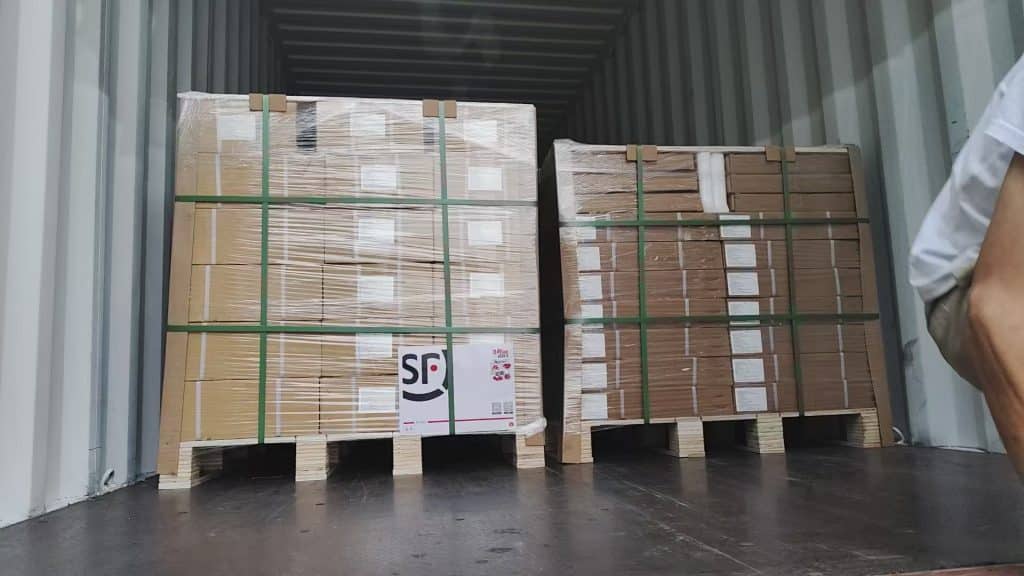
The fix starts with the supplier’s pallet build. I require manufacturers to stack clutch kits in a bonded pattern, using void fillers that compress under load but don’t shift during transit. Standard ISPM 15 heat-treated pallets with 1,200 mm x 1,000 mm bases let you fit 20 pallets double-stacked in a high-cube 40 ft container, maximizing cube utilization to 65 cubic meters of usable space. Never assume the factory’s shipping department knows this; you must send a load plan diagram with the purchase order.
- Pallet design: Specify 4-way entry, 2-stringer construction rated for 2,500 kg static load. Softwood pallets splinter on long-haul ocean freight; birch or heat-treated pine holds up.
- Stacking pattern: Column stacking aligned to the pallet corners, not interlocking, prevents clutch cover distortion. Each layer separated by 3 mm corrugated fiberboard slip sheets to avoid casting surface scuffs that Customs treats as damaged goods.
- Stretch wrap gauge: 80-gauge blown film, minimum 150% pre-stretch, wrapped top to bottom including the pallet base. This stops humidity ingress and keeps the load unitized for forklift handling at the port of discharge.
Labeling isn’t just about barcodes; it’s
For mining clutch kits, add a customs-friendly description: ‘Heavy-duty clutch friction assembly, non-asbestos, for dump truck application’ instead of just ‘auto parts.’ If your shipment contains a flywheel or pilot bearing, flag that on the label and ensure the HS code matches the comprehensive kit classification. Pair this with a packing list that shows per-pallet weight and cubic meter calculation so the freight forwarder can file the ISF-10+2 accurately. Miss that filing by a day, and CBP holds your container until the penalty is settled, no exceptions.
When the freight class calculation and labeling are locked in before the factory books the vessel, you eliminate the two most common causes of unbudgeted landed cost creeping up after the container sails. That discipline is what separates a distributor netting 22% margin from one scratching to break even on a 100-kit shipment.
Customs Clearance Step by Step
Missing one document can trigger a 10‑day hold and a $500+ examination fee.
Customs clearance for heavy-duty mining clutch kits isn’t paperwork—it’s a proof chain. Every line on the commercial invoice must match the packing list weight per pallet and the certificate of origin exactly. Discrepancies are the #1 reason palletized clutch assemblies sit in Customs hold, eating into your margin before the first unit hits your warehouse.
- Commercial Invoice: Must show the correct HS code (usually 8708.93, but verify if the kit includes a pilot bearing or flywheel—that can shift the code and the duty rate), the unit value per kit, Incoterm, and country of origin. List the manufacturer’s full legal name and address, not a trading company alias.
- Packing List: Include gross weight and net weight per pallet, dimensions, and number of kits per pallet. For clutch kits in freight class 70 or 92.5, the density calculation dictates the final class; a packing list that shows under 10 lb/ft³ can bump you to a higher, more expensive class.
- Certificate of Origin: Required to claim preferential duty rates under free trade agreements. The CO must state the kits are wholly obtained or substantially transformed in China. A generic CO without the factory’s chamber of commerce stamp will be rejected, delaying release by 3-7 working days.
- Bill of Lading (Ocean Freight): The B/L must match the invoice exactly—same shipper, consignee, notify party, and cargo description. For FOB shipments from Chinese ports, you control the freight forwarder; if the supplier selects the forwarder, verify the B/L doesn’t list a third-party entity you don’t control.
The certificate of origin is often treated as an afterthought. A distributor lost a 3.5% duty reduction on a $80,000 shipment because the supplier’s CO listed an HS code for ‘clutch parts’ but the invoice said ‘clutch kit assembly.’ The US Customs ruling came back: classification mismatch, full rate applies. The $2,800 savings vanished overnight. Always cross-check the HS code on the CO, invoice, and ISF filing.
For the ISF‑10+2 filing, think of it as the US Customs’ early warning system. You must submit it at least 24 hours before the vessel departs the last foreign port—not 24 hours before arrival. Missing that cutoff means a $5,000 fine, strict liability, no exceptions. The 10 data elements you’re responsible for as the importer include: seller, buyer, importer of record number, consignee number, manufacturer (or supplier), ship-to party, country of origin, commodity HTSUS number, and for FCL shipments—the container stuffing location and consolidator.
- ISF Importer Responsibility: Even if you use a customs broker, the legal liability for accurate and timely ISF filing rests on the ISF Importer—that’s you, the distributor. Never assume your Chinese supplier is filing it. They physically can’t; they lack the required US bond and importer number.
- Critical Timing for FOB Shipments: On FOB terms, the supplier loads the container and you arrange ocean freight. But the factory must give you the container stuffing location and the precise packing list before you can file the ISF. Get a clause in your purchase order that the supplier must provide these details 72 hours before the container gate-in at the port. If they don’t, you’re filing late and paying fines.
- Avoiding Bond Sufficiency Issues: A single-entry bond works for small trial orders, but if you’re importing mining clutch kits regularly, a continuous bond is cheaper per shipment and prevents clearance delays when Customs demands a bond rider for high-value entries. The Merchandise Processing Fee (0.3464%) and Harbor Maintenance Fee (0.125% on ocean freight) also attach at clearance—budget a combined $200+ for a $50,000 shipment.
Customs will flag heavy palletized cargo for exam more often than light loose cartons. Clutch kits on a 40×48-inch pallet stacked four feet high look dense on X‑ray. If the packing list shows a density below 10 lb/ft³ but the invoice declares a value that suggests otherwise, expect a VACIS or tailgate inspection. The fix is simple: pack kits so the calculated density aligns with the freight class you actually want, and label every pallet with the 5-digit ITN number from your AES filing. No label, no proof, longer hold.
Budgeting Landed Cost: A Real Example
The hidden fees—MPF, HMF, and broker charges—add over $200 to a $50,000 shipment.
Too many distributors run a simple calculation: FOB price × 1.05 for duty, and call it a day. That leaves real money on the table. The reality for a 100-kit shipment of mining truck clutches, landed at a US port, is as follows. Assume a
- Customs Duty (2.5%): $45,000 × 2.5% = $1,125. Verify the rate with your broker—if the kit includes a flywheel or pilot bearing, the subheading might shift and change this number entirely.
- Merchandise Processing Fee (MPF): 0.3464% of the entered value. $45,000 × 0.003464 = $155.88. Capped at $538.40, so larger shipments don’t multiply this charge.
- Harbor Maintenance Fee (HMF): 0.125% on the ocean freight portion only. If freight was $3,500, HMF = $4.38. Small, but forgotten by most first-timers.
- Customs Broker Fee:Flat rate for entry filing, typically $150–$300. A budget of $200 is assumed. This covers the ISF-10+2 and clearance.
Total landed cost before domestic trucking: $45,000 (CIF) + $1,125 (duty) + $155.88 (MPF) + $4.38 (HMF) + $200 (broker) = $46,485.26. That’s $464.85 per kit landed, not $441 if you only tacked on duty. On a full container of 250 kits, the gap widens to several thousand dollars. The lesson? When you negotiate FOB pricing, always run the full US customs math before you agree on a sales price back home. And if the supplier’s pre-production sample passed with a tight quality tolerance, lock that spec down—customs doesn’t care, but your end customer does when the mass production run arrives.
| Cost Element | Amount | Details |
|---|---|---|
| Ex‑Factory Value (100 Kits) | $60,000 | FOB Qingdao; heavy‑duty mining clutch kits @ $600/kit |
| Ocean Freight (40 ft Container) | $3,200 | Shanghai → US West Coast; freight class 70 for palletized loads averaging 10 lb/ft³ |
| Marine Insurance (0.3% CIF+10%) | $203 | Covers full risk on high‑torque industrial assemblies |
| Customs Duty (2.5%) | $1,500 | HS 8708.93; verify subheading if kit includes flywheel or pilot bearing |
| Merchandise Processing Fee (0.3464%) | $208 | Often overlooked; calculated on entered value |
| Harbor Maintenance Fee (0.125%) | $4 | Assessed on ocean freight; easily missed |
| Customs Broker Fee | $180 | Includes ISF‑10+2 filing and entry preparation |
| Total Landed Cost to Port | $65,295 | Hidden fees (MPF + HMF) add $212 to the shipment; excludes inland trucking |
Conclusion
Getting a mining clutch shipment across the ocean without a cost blowout comes down to three things: an HS code your broker has validated against the exact kit components, an Incoterm that transfers risk at the right point for a 200 kg pallet, and a landed cost calculation that accounts for the Merchandise Processing Fee and Harbor Maintenance Fee—two line items that quietly add over $200 to a $50,000 order. Nail those three, and you eliminate the surprise invoices that eat margin after the container leaves Shanghai.
Write this down before your next supplier call: “Pack to a minimum of 10 lb per cubic foot.” If the pallet density drops below that, freight class jumps and your ocean rate stops making sense. For a batch that meets that benchmark and gets the paperwork right, review the full-duty clutch kits designed for mining fleets—tested at the factory, with documentation built for customs clearance.
Frequently Asked Questions
What HS code for mining clutch kits?
Mining clutch discs, covers, and release bearings normally fall under HS 8708.93. If the kit includes a flywheel or pilot bearing, classification may shift, so always confirm with a licensed broker. Verify classification with a customs broker before shipping.
FOB or CIF for heavy clutch freight?
FOB gives you control over the carrier and freight quality, which matters when pallets exceed 200 kg. CIF may look cheaper upfront but can hide low-grade shipping that damages clutches in transit. Request FOB pricing to control freight quality and insurance.
How to avoid freight reclassification?
Keep pallet density above 10 lb/ft³ by stacking clutch kits tightly and using dense dunnage. Density below that threshold triggers reclassification and typically adds 30% to the freight bill. Confirm pallet density with your forwarder before container loading.
What documents for customs clearance?
You’ll need a commercial invoice, packing list, and certificate of origin at minimum. For US imports, file ISF-10+2 at least 48 hours before vessel departure to avoid penalties. Submit ISF-10+2 at least 48 hours before vessel departure.
How to calculate landed cost per kit?
Add FOB price, ocean freight, insurance, duty (using correct HS rate), harbor maintenance fee, and broker charges. A 100-kit shipment example shows hidden fees can shift the real cost by. Request a landed cost breakdown from your forwarder before placing the order.