
The internal combustion engine produces power, but without a mechanism to manage that power, a vehicle would be uncontrollable. The clutch system is the unsung hero of the drivetrain, bridging the gap between the engine’s raw torque and the transmission’s gears. Whether you are a parts distributor, a fleet manager, or a mechanic, understanding the physics and mechanics of the clutch is essential for selecting high-quality aftermarket components.
The quality of a clutch kit—specifically the friction coefficient of the disc and the clamping force of the pressure plate—directly dictates the longevity of the vehicle’s drivetrain. In the heavy-duty aftermarket, durability isn’t just a feature; it’s the baseline requirement.
“The number one cause of premature clutch failure in the aftermarket isn’t poor installation—it’s inconsistent friction material quality. For B2B buyers, sourcing kits that adhere to ISO/IATF16949:2016 standards is the only way to guarantee OE-level performance.”
1. Introduction to the Automotive Clutch System
Every manual transmission vehicle relies on friction to move. The concept is simple: connect two spinning discs smoothly enough to transfer energy but firmly enough to prevent slipping under load. However, the engineering behind this “smooth connection” involves complex thermal dynamics and precise mechanical leverage.

The Role of Torque Management
In an internal combustion engine, torque is produced only when the engine is rotating. Unlike an electric motor, an engine stalls if the wheels stop while connected directly to the crankshaft. The clutch solves this physics problem.
2. Types of Clutches: Classification and Applications
Not all torque is created equal, and neither are clutches. From compact passenger cars to heavy-duty agricultural machinery, the design of the clutch assembly changes based on the torque rating and heat dissipation requirements.
| Type | Cooling Method | Key Advantage | Application |
|---|---|---|---|
| Single-Plate Dry Clutch | Air Cooled | High efficiency, simple maintenance. | Passenger cars, Light Trucks |
| Multi-Plate Wet Clutch | Oil Bathed | Superior heat dissipation. | Motorcycles, Heavy Equipment |
| Dual-Clutch (DCT) | Air or Oil | Lightning-fast pre-selected shifting. | Performance, Modern Automatics |
Classification by Cooling: Dry vs. Wet
The primary enemy of any friction system is heat.
Dry Clutches operate in an air environment within the bell housing. They rely on surface area and airflow to dissipate heat.
Wet Clutches are submerged in engine oil or transmission fluid. The fluid acts as a coolant, keeping the friction plates at a stable temperature.
Classification by Mechanism: Single vs. Multi-Plate
Single-Plate Dry Clutch: The industry standard. It balances cost, ease of replacement, and torque capacity sufficient for 90% of vehicles.
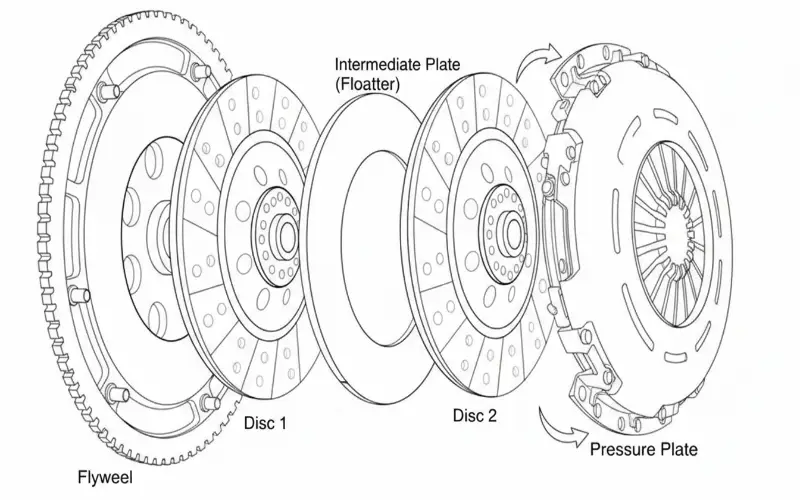
Multi-Plate Clutch: Used when torque exceeds the capacity of a single disc’s surface area.
“Never substitute a clutch type based solely on size. Always match the friction material to the vehicle’s intended use.”
3. Anatomy of a Clutch Kit: Key Components Breakdown
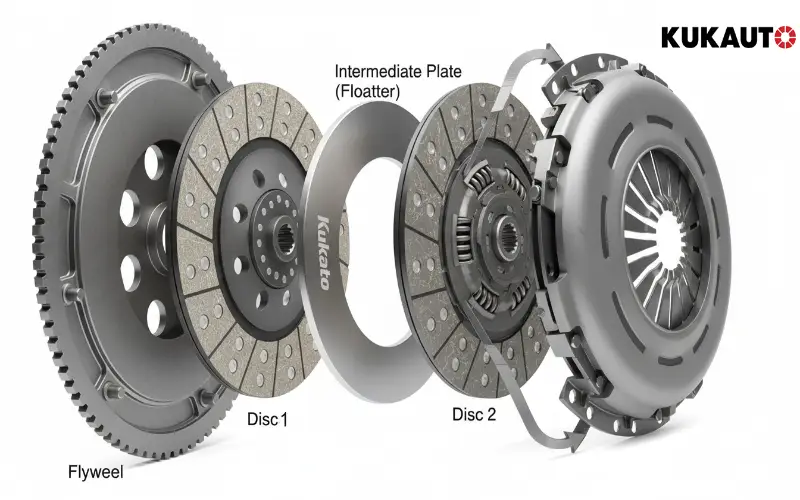
To evaluate the quality of a clutch kit, buyers must look beyond the box and inspect the individual components. A standard “3-Piece Kit” consists of the Cover Assembly, Friction Disc, and Release Bearing.

Critical Components Breakdown
1. The Pressure Plate
The muscle of the system. It bolts to the flywheel and contains the Diaphragm Spring, which determines pedal feel.
2. The Clutch Disc
The wear item. Features Friction Facings (Organic or Ceramic) and Torsion Springs (dampeners) that absorb engine shock.
3. The Release Bearing
The interface between the stationary fork and spinning plate. It pushes the diaphragm fingers to release clamp load.
4. How Does a Clutch Work? The Physics of Engagement
Understanding the sequence of events when a driver presses the pedal helps in diagnosing issues like “dragging” or “slipping.” It is a game of leverage and friction.

Step 1: Disengagement (Pedal Down)
The driver presses the pedal. Hydraulic fluid or a cable pushes the clutch fork. The fork pushes the release bearing into the center of the diaphragm spring. Acting like a seesaw, the outer edge of the spring lifts the pressure plate away from the flywheel. The clutch disc is now free-floating, and no torque is transmitted.
Step 2: Engagement (Pedal Up)
As the driver releases the pedal, the release bearing retracts. The diaphragm spring applies massive force (clamping load) to the pressure plate. The plate pinches the clutch disc against the spinning flywheel. Friction synchronizes their speeds, and the vehicle moves.
5. Applications of Clutches: From Cars to Heavy Machinery
While the fundamental principle of friction remains the same, the application defines the design. A clutch built for a highway cruiser would fail instantly in a bulldozer. Understanding these specific requirements is crucial for distributors managing diverse inventories.
🚗 Passenger Cars (PV)
Focus: Comfort, NVH (Noise, Vibration, Harshness), Smooth Engagement.
Uses Organic Friction Material to ensure smooth starts and quiet shifting. The torsion springs are tuned to absorb the lighter vibrations of high-revving gasoline or diesel engines.
🚚 Commercial Vehicles (CV)
Focus: Durability, Heat Dissipation, Longevity.
Heavy trucks (Class 5-8) use larger diameter clutches (up to 430mm). Often feature Ceramic or Sintered buttons to handle the massive torque of turbo-diesel engines and frequent stop-start cycles.
🚜 Agricultural Machinery
Focus: Constant Torque, PTO Integration.
Tractors often use Dual Clutches—one stage controls the wheels, while the second stage controls the Power Take-Off (PTO) shaft for implements. These must function in dusty environments.
🏗️ Construction Machinery
Focus: Extreme Load, Shock Resistance.
Excavators and loaders operate under extreme stress. These clutches feature reinforced hubs and Sintered Iron facings to prevent shattering under shock loads when hitting resistance.
“For aftermarket distributors, the highest margin growth is currently in the ‘Light Commercial’ sector—delivery vans and last-mile logistics vehicles that require heavy-duty components but drive on city streets.”
6. Common Failures & Troubleshooting
For mechanics and parts retailers, accurately diagnosing a clutch failure reduces warranty claims and returns. Most “clutch failures” are actually symptom-based.
1. Slippage
Symptoms: RPM increases without acceleration; burning smell.
Causes: Worn friction material (end of life), oil leak contaminating the disc (rear main seal failure), or weak pressure plate springs.
2. Chatter (Judder)
Symptoms: The car shakes or shudders violently when starting from a stop.
Causes: Warped flywheel surface (hot spots), oil contamination, or broken motor mounts mimicking clutch chatter.
3. Dragging
Symptoms: Grinding gears when shifting; vehicle creeps forward with pedal depressed.
Causes: Clutch not disengaging fully. Usually a hydraulic issue (master/slave cylinder) or a warped clutch disc.
7. Frequently Asked Questions (FAQ)
How long should a clutch last?
A quality aftermarket clutch typically lasts between 50,000 to 100,000 miles, depending heavily on driving style. City driving and towing reduce lifespan significantly compared to highway driving.
Can I replace just the clutch disc?
Technically yes, but it is strongly discouraged. The pressure plate and release bearing wear at similar rates. Replacing only the disc often leads to slippage shortly after, doubling labor costs.
What is the difference between Organic and Ceramic facings?
Organic facings (standard) offer smooth engagement and quiet operation. Ceramic facings (performance/heavy-duty) withstand higher heat and torque but engage more aggressively (causing “chatter”) and wear the flywheel faster.
Why Choose Kukauto for Wholesale Clutch Kits?
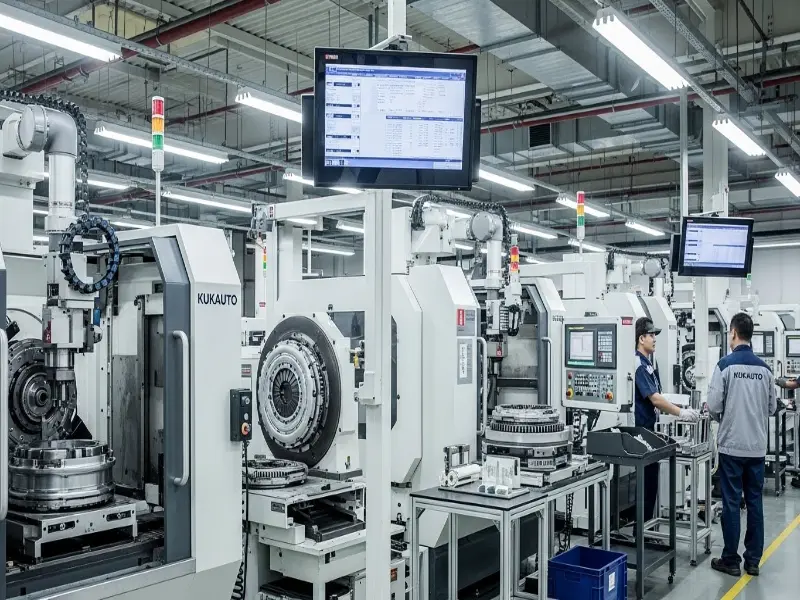
Sourcing from Kukauto means partnering with a manufacturer that understands the global aftermarket. Located in Shandong, we combine cost-efficiency with OEM-level rigor.
- ✓ High Volume: 200,000 sets/year production capacity.
- ✓ Certified Quality: ISO/IATF16949:2016 accredited facility.
- ✓ Fast R&D: 2-week turnaround for new CAD models.
- ✓ Low MOQ: Flexible ordering for distributors.
Ready to Upgrade Your Inventory?
Contact our sales team for a custom quote today.
📧 Email: [email protected]
Response time: Within 24 hours