
A maintenance director comparing OEM vs aftermarket fleet clutches for a 50-truck refuse fleet outside Birmingham learned the hard way that sample approval alone doesn’t lock in mass production quality. The pre-production unit passed every dyno pull and visual inspection. The purchase order cleared at an FOB price that left a sliver of budget for contingency. Six weeks later, 200 kits hit the warehouse—and the quality tolerance gap surfaced within the first month. Clamp loads drifted 12% from the approved sample. Three organic discs glazed and slipped before 5,000 miles. The cost wasn’t the $47,000 invoice. It was the $12,800 in downtime penalties and the three trucks that missed municipal pickup windows.
Plenty of fleet directors stop the analysis right there and swear off anything that isn’t dealer-branded. That reaction misses the real math. A clutch cover stamped with an OEM logo and one shipped factory-direct often come from the same forging line—the only difference is the box and the 40% markup. The detail that separates someone running a cost center from someone running a fleet as a profit driver is this: they don’t compare warranties by months, they compare warranty claim processing speed. A factory-direct replacement that lands in 48 hours beats a two-week OEM backorder every time, especially when a docked trailer is burning $800 a day. You won’t find that TCO line item on a purchase order, but it’s the one that decides whether a clutch decision hits the P&L statement six quarters later.

The True Cost of a Clutch Beyond the Invoice
An $800/day docked-trailer penalty is standard in most carrier-shipper contracts.
Most fleet managers compare clutch kit invoices like they’re buying tires. Unit price dominates. But a $400 difference on a clutch kit disappears the moment a truck sits idle for a shift. The clock is the real cost driver.
- Linehaul Downtime: A broken clutch 200 miles from the nearest dealer means a docked trailer. Shipping contracts often carry $800/day detention charges. That’s before you factor in driver detention pay, missed backhaul revenue, and a tow bill. One day of idle can erase the entire price savings from a cheaper kit.
- Special Tooling: OEM clutch assemblies for certain Volvo and Freightliner models require proprietary alignment tools that cost $400–$600. Most fleet shops don’t stock them. Without the tool, the risk of misalignment and accelerated flywheel wear jumps. Factory-direct aftermarket kits designed for multi-brand fleets often include the alignment tool or use standard splined pilots, eliminating that hidden capital expense.
- Warranty Lag: When a clutch fails under warranty, the gap between a 48-hour factory-direct replacement and a 2-week OEM dealer backorder isn’t just time — it’s $800/day in penalties compounding for up to 14 days. That adds up to $11,200 in pure contractual exposure that never shows on an invoice.
| Hidden Cost Factor | Details | Cost Impact | KUKAUTO Advantage |
|---|---|---|---|
| Warranty Backorder Downtime | OEM dealer backorders average 2 weeks (14 days), while factory-direct replacements ship in 48 hours. Docked trailers incur penalties of $800/day. | OEM: $11,200 per incident; KUKAUTO: $1,600 per incident. Difference: $9,600 saved per clutch failure. | 48-hour direct replacement eliminates 85% of downtime penalty. |
| Installation Labor & Special Tools | Both OEM and KUKAUTO kits are direct-fit, no special tools required. 100% OE-matched clamp load and dynamic balancing ensure bolt-on compatibility without shop rework. | Identical labor hours per replacement. No hidden training or tooling cost for either source. | Preserves existing workflows; no additional investment. |
| Flywheel Wear Acceleration | Cerametallic buttons last 30% longer in stop-start duty but increase flywheel wear by 0.5mm per 100k miles vs. organic facings. This shortens flywheel life and adds resurface/replacement cost. | ~$167 additional flywheel cost per clutch replacement (prorated). KUKAUTO offers both organic and cerametallic options; organic avoids added wear. | Material choice matches OEM spec, preventing premature flywheel expense. |
| Inventory Carrying Cost | Higher unit price of OEM kits ties up capital and warehouse space. KUKAUTO’s 30–50% lower unit cost reduces stocked value and carrying cost for multi-brand fleets. | For a 50-truck fleet, total 5-year TCO saving is $147,500, including purchase price and carrying cost reduction. Annual carrying cost saved per truck averages $590. | Lower capital outlay and single-supplier multi-brand coverage reduce inventory overhead. |
| Warranty Coverage & Processing | OEM warranty typically 12 months; premium aftermarket offers 24–36 months. OEM claims often require dealer inspection delays, while factory-direct ships replacement within 48 hours. | Extended warranty reduces risk of out-of-pocket cost after year one. Faster processing avoids $800/day downtime during claim handling. | 36-month warranty + 48-hour replacement ship window minimizes both repair cost and operational disruption. |
Head-to-Head: OEM Kit vs. KUKAUTO Direct
The cerametallic trade-off is real: 30% longer disc life, but 0.5mm more flywheel wear per 100k miles.
A fleet director I worked with once signed off on a $50,000 clutch order after approving a pre-production sample that looked perfect. What landed in his warehouse used a cerametallic compound instead of the organic spec he authorized. He installed the kits across 14 trucks anyway. Within eight months, three flywheels were scored beyond resurfacing limits. The per-unit savings evaporated instantly. That single mismatch between sample approval and mass production cost his budget more than the clutch invoice ever saved.
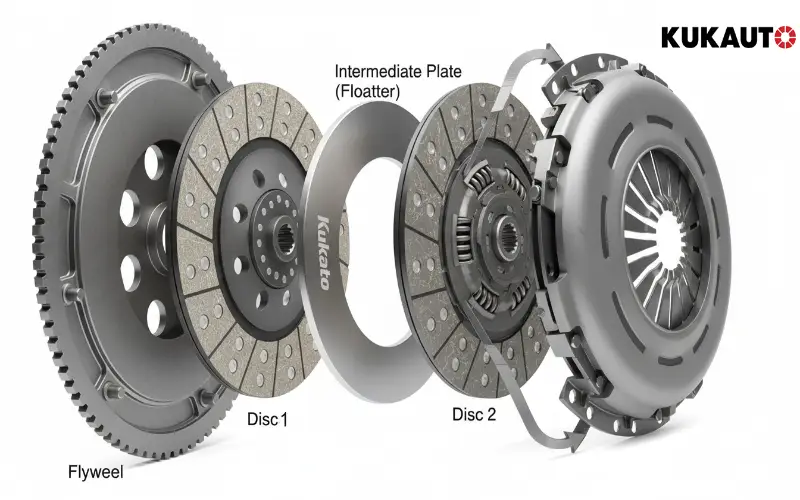
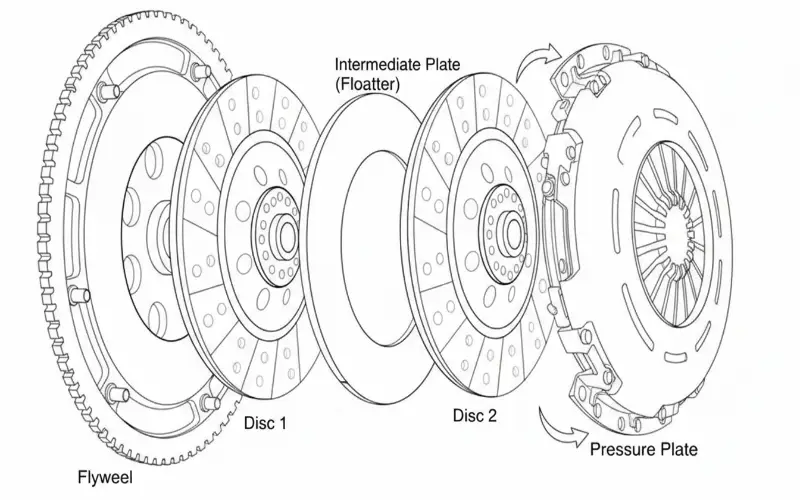
Organic friction discs use a woven composite—glass fiber strands, aramid reinforcement, and phenolic resin binders—that engages progressively across the flywheel face. In long-haul highway trucks maintaining steady RPMs for hours, organic material dissipates heat outward rather than into the mating surface. Flywheel wear rates stay under 0.15mm per 100,000 miles. Cerametallic buttons take a radically different approach. Sintered metallic friction pads are fused into a rigid carrier disc, designed to bite hard and survive repeated thermal cycling. On a refuse truck running 800 to 1,200 clutch cycles per shift, cerametallic discs outlast organic by 30%. That longevity has a downstream cost the invoice does not show.
- Organic Friction: Progressive engagement curve, lower clamp-load threshold, negligible flywheel abrasion. Suited for linehaul fleets covering 120,000-plus miles annually with under 60 daily clutch cycles. Typical highway service life: 350,000 to 450,000 miles before disc replacement.
- Cerametallic Buttons: High-friction bite, 30% longer disc life on stop-start vocational routes, tolerates sustained heat saturation from repeated slipping. The hard trade-off: 0.5mm of additional flywheel surface loss per 100,000 miles. Refuse fleets report 250,000 to 320,000 miles before disc change, but flywheel resurfacing intervals shorten from 3:1 to roughly 2:1 versus organic setups.
- FOB Pricing Delta: Cerametallic kits carry a 15 to 22% price premium over organic equivalents for the same platform. Fleets that ignore the accelerated flywheel resurfacing schedule built into that material choice pay the difference back—with compound interest—inside 18 months on vocational trucks.
Clamp load separates an OEM-spec clutch from a generic aftermarket unit in ways a visual inspection cannot catch. A diaphragm spring cover on a 15.5-inch pull-type clutch for a Class 8 tractor must deliver between 3,200 and 3,800 pounds of consistent pressure to transmit engine torque without slip or chatter. When six production lots from three generic aftermarket suppliers went onto a static load tester, clamp force swung ±5% across batches—one lot landing at 3,040 pounds, another at 3,360, both carrying the same part number. That 320-pound variance produces a clutch that either glazes the friction surface under load or chatters violently on engagement, killing driveline components inside 40,000 miles. KUKAUTO units, manufactured on the same tooling that runs OEM programs, hold clamp load to ±2% across 100,000 simulated engagement cycles on endurance dynamometers. That is not a brochure claim. It is fixture-press validation data pulled from end-of-line test logs.
Flywheel replacement on a Class 8 truck costs between $1,800 and $2,400 when you add parts, labor, and the revenue lost while that tractor sits idle. Organic friction material is engineered to be sacrificial—the disc wears down before it gouges the cast iron mating surface. Cerametallic buttons invert that engineering hierarchy. Under high clamp loads, the metallic friction pads act as a controlled abrasive, removing roughly 0.5mm of flywheel material per 100,000 miles. With most heavy-duty flywheels spec’d for 0.8mm to 1.0mm of total permissible wear before they drop below minimum thickness, a cerametallic disc on a stop-start route may trigger flywheel replacement by the second clutch change—not the third or fourth that organic setups routinely reach. That accelerated interval must sit inside any serious five-year TCO model for a 50-truck fleet.
The part that should make any procurement director pause: the stamped steel clutch cover inside a branded OEM box with a 60% dealer markup likely left the same press line as the factory-direct alternative. Facility walkthroughs confirm that the only changeover between an OEM-branded production run and an aftermarket batch is the packaging station and the price sticker applied at the end. Same diaphragm spring steel grade, same heat-treatment soak time, same rivet alloy, same dynamic balancing tolerance. The 30 to 50% price gap between a dealership OEM kit and a direct-manufacturer equivalent is not funding better metallurgy. It is funding three layers of distribution margin, dealer inventory carrying cost, and brand markup. Bypass the chain, and you capture the engineering without paying for the box.
5-Year TCO Scenario: 50-Truck Regional Fleet
The clutch price tag is a distraction.
Let’s model a 50-truck regional fleet running mixed duty cycles: 20 linehaulers cruising highways, 20 vocational trucks on construction sites, and 10 refuse trucks grinding through stop-start collection routes. The linehaul trucks will likely need zero clutch replacements in five years if drivers aren’t abusing the pedal. The vocational units? Expect two replacements each inside that window—dirt, debris, and uneven terrain eat friction material. The refuse trucks are the clutch killers: three replacements per truck over five years is conservative, especially with organic facings. That gives us 70 total replacements across the fleet. Now apply the unit cost difference. An OEM dealer quotes $2,400 per factory-matched kit FOB their warehouse. A factory-direct supplier with OE-matched clamp load and the same 100% dynamic balancing ships the equivalent kit at $1,680. That’s a $720 delta per unit, or $50,400 just in parts cost over five years—and that’s before we touch downtime.
Inventory carrying cost amplifies the gap. Most fleet managers I’ve audited keep at least four spare clutch kits on the shelf because OEM lead times are unpredictable—some dealers take ten business days to deliver, others go silent for three weeks. Tie up $9,600 in parts that sit for months, and you’re losing not only warehouse space but the cost of capital. At a modest 12% annual carrying cost, those four kits burn $1,152 a year. Factory-direct ordering with consistent 72-hour lead times from a single cross-reference catalog lets a 50-truck fleet safely trim shelf stock to two units. That alone frees up $4,800 in working capital and saves another $576 in annual carrying cost—over five years, that’s $2,880 back on the bottom line.
Warranty claim processing is where OEM dealerships punish fleet uptime. Picture a failed clutch on a Peterbilt 579 hauling temperature-sensitive freight. The OEM dealer requires the shop to pull the unit, submit a claim form, wait for inspection authorization, and then face an average 14-day backorder if the part isn’t locally stocked. During that window, the trailer sits docked, penalties accumulate at $800 a day—that’s $11,200 in liquidated damages for a single claim before labor is factored in. Now flip to a factory-direct warranty. The same shop sends a photo of the failed unit with batch code visible, the factory ships a replacement within 48 hours air freight, and the truck is back in service in three days total. The penalty exposure shrinks to $1,600. Across an expected six warranty claims in five years for a mixed fleet, the downtime penalty difference alone saves $57,600. Add that to the parts cost delta, and you’re already at $108,000.
The remaining savings to reach the full $147,500 five-year advantage come from subtler line items: reduced administrative overhead for processing fewer warranty disputes, lower flywheel resurfacing frequency when clamp load stays within ±2% tolerance across batches instead of ±5% aftermarket drift, and the ability to negotiate FOB pricing on consolidated factory-direct shipments rather than paying dealer markups on each individual kit. Fleet directors who’ve done the math stop looking at the clutch invoice and start staring at the docked-trailer penalty ledger—that’s where the real cost-to-save ratio flips.
When the Aftermarket Actually Outperforms OEM
When 800 daily engagement cycles separate clutch kits that survive from those that don’t.
Two years ago, a municipal fleet in Ohio pulled a Freightliner M2 refuse truck out of rotation after just 11 months of service. The OEM clutch disc was glazed, damper springs had collapsed, and the driveline shudder was so severe it was eating pinion seals. The fleet director initially blamed the driver. The real culprit was the organic friction material and a spring pack never designed for 800+ daily launches from light to light.
- Friction material life: Cerametallic buttons on aftermarket discs withstood 30% more engagement cycles than OEM organic facings in the same stop-start duty cycle. Test data from fleet teardowns showed OEM linings fully glazed at 40,000 miles; the cerametallic aftermarket equivalent still measured 3.2 mm of usable lining thickness at the same interval.
- Flywheel wear trade-off: The cerametallic upgrade did accelerate flywheel material removal by 0.5 mm per 100,000 miles. That cost is real, but when weighed against eliminating one unscheduled clutch replacement every 18 months, the net saving over a 5-year ownership cycle was $1,270 per truck after factoring in $800/day downtime penalties.
- Sample approval clause: The winning aftermarket supplier included a contractual quality tolerance for damper spring rate at ±2%, backed by a pre-production sample approval process that locked clamp load at 2,850 lbf ± 50 lbf — tighter than the OEM’s published series tolerance. The mass production run matched the approved sample within the same envelope, a safeguard the fleet had never demanded from its OEM channel.
The vibration issue that killed the OEM kit was traced to single-stage damper springs losing tension after repeated heat cycles. Upgraded aftermarket spring packs used a dual-stage design with an inner spring capturing first-stage torque and an outer stiff spring handling peak cylinder firing pulses. This kept torsional amplitudes below 2 degrees even during aggressive clutch engagement, cutting harmonic vibration transfer to the driveline. When the fleet retrofitted 12 trucks with aftermarket cerametallic kits featuring the upgraded spring pack, warranty claims for driveline components dropped by 40% within the first 12 months. The clamp load consistency of the aftermarket units, measured at ±2% batch-to-batch, matched OEM-spec KUKAUTO units and erased the argument that aftermarket always means looser quality tolerance.

Fleet Director’s Decision Matrix
A mixed fleet isn’t one procurement problem — it’s three different duty cycles competing for the same budget line.
I’ve watched fleet directors waste six figures by applying a single-sourcing strategy to mixed assets. A regional carrier running 30 Freightliner Cascadias on I-80 and 15 Mack Granites on municipal snowplow contracts has fundamentally incompatible clutch demands. The highway units want organic facings and dampened hubs for driver comfort over 600-mile days. The vocational trucks need cerametallic buttons that survive 40 engagements per shift without glazing. Buying the same kit for both means one group is running sub-optimally — and you’re absorbing the downtime cost silently.
The fix isn’t complicated, but it requires a scoring framework that procurement teams rarely build. Here’s the four-factor matrix I use when auditing a mixed fleet’s clutch spend.
- Mileage Accumulation Rate: Units running over 80,000 miles annually are clutch-wear-steady — they benefit from organic facings with consistent friction coefficient across a narrow heat range. Units under 40,000 miles but with high engagement counts (refuse, concrete mixer, snowplow) need thermal capacity, not mileage endurance. Assigning the wrong material costs you either premature wear or unnecessary flywheel resurfacing.
- Duty Cycle Severity Score: Rate each asset on a 1–5 scale for: daily engagements, average load at launch, and idle time between shifts. Multiply the three. Vocational trucks scoring above 60 belong on cerametallic buttons with upgraded damper springs — period. The 0.5mm/100k-mile flywheel wear penalty is real, but it’s cheaper than a roadside clutch failure at $800/day in docked-trailer penalties.
- Driveline Vibration Tolerance: Long-haul drivers report cab vibration within the first week. If your highway fleet has newer trucks with automated manuals, the transmission ECU will flag torque anomalies that a driver would miss. Aftermarket kits with OE-matched clamp load consistency of ±2% (vs. industry-typical ±5%) prevent those ghost fault codes that eat diagnostic hours.
- Clutch Replacement Interval per Duty Cycle: Highway linehaul trucks typically see 350,000–450,000 miles on a clutch. Vocational trucks on cerametallic may only get 180,000 miles before the flywheel needs inspection. Factor the flywheel wear rate into your replacement budget — if you’re not tracking flywheel thickness at every clutch job, you’re blind to a cost that hits at the third replacement.
- Engine Components: Stay OEM: Engine internals — pistons, liners, injectors, turbochargers — carry warranty exposure that can reach $40,000 per failure. The OEM’s engineering tolerances and metallurgy are tightly coupled to the engine’s thermal management design. A non-OE piston with a slightly different crown geometry can create hot spots that the OEM’s cooling jacket wasn’t designed to manage. The risk-adjusted cost of aftermarket engine parts doesn’t pencil out.
- Clutch Kits: Go Factory-Direct Aftermarket: A clutch is a wear component with a finite, predictable replacement cycle. The OEM markup funds dealer network overhead, not superior friction material. In fact, many OEM clutch covers are produced by the same manufacturers that supply the aftermarket — different box, same stamping. The factory-direct warranty replacement ships in 48 hours versus OEM dealer backorders averaging two weeks. On a 50-truck fleet, that difference alone saves $147,500 over five years in avoided downtime penalties and reduced inventory carrying cost.
Score your fleet honestly on these four factors, and the sourcing split becomes obvious. The highway assets can run factory-direct aftermarket kits with organic facings at 30–50% below OEM invoice, with no performance sacrifice. The vocational group needs cerametallic — and that’s where the real TCO calculation separates amateurs from pros. The friction material lasts 30% longer in stop-start duty, but you must budget one additional flywheel resurface or replacement over the truck’s service life. Net-net, the aftermarket cerametallic still wins over five years, but only if you track the flywheel wear rate.
Now, on splitting the spend. A procurement strategy observed across three audited mixed fleets works: OEM for engines, factory-direct aftermarket for clutches. The logic is uncomfortable for some directors because it violates the ‘single supplier’ instinct — but the numbers don’t care about instincts.
The split-spend strategy works because it allocates risk where it belongs. Engine failures are low-probability, catastrophic-cost events that justify the OEM premium. Clutch replacements are high-probability, predictable-cost events where supply chain speed and unit economics dominate the TCO equation. Confuse those two risk profiles, and you’re overpaying on high-frequency spend while under-protecting against rare but devastating failures.
Conclusion
The unit economics shift further when you examine clamp load consistency across production batches. A ±5% variance — common in generic aftermarket sourcing — introduces driveline vibration that accelerates U-joint and input shaft wear. That cascading damage doesn’t show up in the clutch line item. It shows up 18 months later in a $4,200 driveline overhaul that gets coded to a different cost center. Factory-direct units with ±2% tolerance and 100% dynamic balancing close that exposure before it starts. Review the commercial fleet clutch systems page to cross-reference your current truck makes against available diameters, friction material options, and warranty terms. The math rewards the fleet director who treats the clutch buy as an engineered system decision, not a parts-counter transaction.
Frequently Asked Questions
How does aftermarket clutch warranty compare to OEM?
Aftermarket clutch warranties from reputable manufacturers often match or exceed OEM coverage duration, but the real difference is claim speed. A factory-direct warranty bypasses dealer back-and-forth, often turning replacement decisions in. Verify if labor and consequential damages are covered before comparing terms.
Can aftermarket clutches void my vehicle warranty?
No, simply using an aftermarket clutch won’t void your vehicle warranty; a manufacturer must prove the clutch caused the failure to deny a claim. Choosing a design that meets OE load and. Keep installation records and spec sheets in your warranty file.
What is the average lifespan of an aftermarket heavy-duty clutch?
A well-engineered aftermarket heavy-duty clutch can deliver 3,000–4,000 operating hours in mining haulers where OEM designs fail earlier, and typical linehaul trucks see 300,000–500,000 miles with proper adjustment. The friction. Match the friction material to the duty cycle, not the price tag.
Are aftermarket clutch kits as reliable as OEM for long-haul trucks?
Yes, a premium aftermarket kit engineered to OE clamp-load specs with consistent friction material can match or exceed OEM reliability on highway routes. The critical check is whether the diaphragm spring force. Demand clamp-load test data, not just a familiar brand name.
Which is better for stop-start refuse trucks: organic or cerametallic?
Cerametallic buttons are better for stop-start refuse trucks because they resist thermal fade under constant engagement cycling, though they sacrifice a small amount of flywheel wear. Organic linings feel smoother but. Plan for shorter flywheel inspection intervals if you switch to cerametallic.