Introduction: Friction Coefficient is the “Heartbeat” of a Clutch
When a 40-ton truck starts on a 15% gradient, physics dictates that a massive amount of energy must be transferred from the engine to the wheels instantly. The component mediating this transfer is the clutch, and its performance is governed by a single, critical number: the Friction Coefficient (represented as μ or Mu).
Defining Friction Coefficient (μ)
Technical Definition: The friction coefficient (μ) is a dimensionless scalar value representing the ratio of the force of friction between two bodies and the force pressing them together. In clutch terms, it quantifies how effectively the friction material “grips” the flywheel surface under the clamping load of the pressure plate.
Typical Ranges for Clutch Facings:
- 0.25 – 0.35 (Standard Organic): Used in passenger cars for soft, smooth engagement.
- 0.35 – 0.45 (Premium Heavy-Duty): The standard for commercial trucks (Kukauto’s baseline), offering a balance of grip and drivability.
- 0.45 – 0.55+ (Cerametallic/Sintered): Used in tractors and racing cars. Provides extremely high torque capacity but with aggressive, “on/off” engagement characteristics.
It is not just a number; it is the measure of torque capacity.
In simple terms: Torque Capacity = Clamp Load × Mean Radius × Friction Coefficient (μ) × Number of Surfaces.
If μ drops, torque capacity drops. If it drops below the engine’s output, the clutch slips, fuel is wasted, and components burn.
The Misconception: Why “Higher” isn’t always “Better”
Many buyers mistakenly ask for the highest possible μ. However, a coefficient that is too high (e.g., >0.60 for a road truck) causes “grabby” engagement. This lack of controllability creates shock loads that can snap axle shafts and destroy universal joints. The goal is controllability and stability.
The Enemy of Friction: Understanding “Heat Fade” (Thermal Decay)
This is the ultimate litmus test for clutch quality. Inferior products often perform perfectly when cold (20°C), but fail catastrophically when hot.

What is Friction Fade?
As a clutch slips during engagement, temperatures can spike to 300°C within seconds. At these temperatures, the phenolic resins in cheap friction materials begin to turn into gas. This gas creates a microscopic floating layer between the disc and the flywheel, causing the coefficient (μ) to plummet—often from 0.40 down to 0.15. This is Heat Fade.
“Stability is safety. For a driver navigating a heavy mining truck down a steep slope, an unpredictable clutch is terrifying. They need the pedal feel to be exactly the same at 300°C as it is at 20°C.”
The “Recovery” Phase
Equally important is recovery. After the clutch cools down, does the grip return? Inferior materials “glaze” permanently, leaving a glass-like surface that never regains its original friction properties. Kukauto’s formula is designed for 100% recovery.
Material Science: How Different Materials Affect the Coefficient
μ: 0.35 – 0.45
Smooth engagement, quiet operation. Ideal for on-highway trucks and passenger cars. Limited heat tolerance.
μ: 0.45 – 0.55
Aggressive grip, high heat capacity. Ideal for tractors, mining, and racing. Can be “chattery” on engagement.
μ: 0.40 – 0.48
The best of both worlds. Copper wire strands act as heat sinks to dissipate thermal energy rapidly.
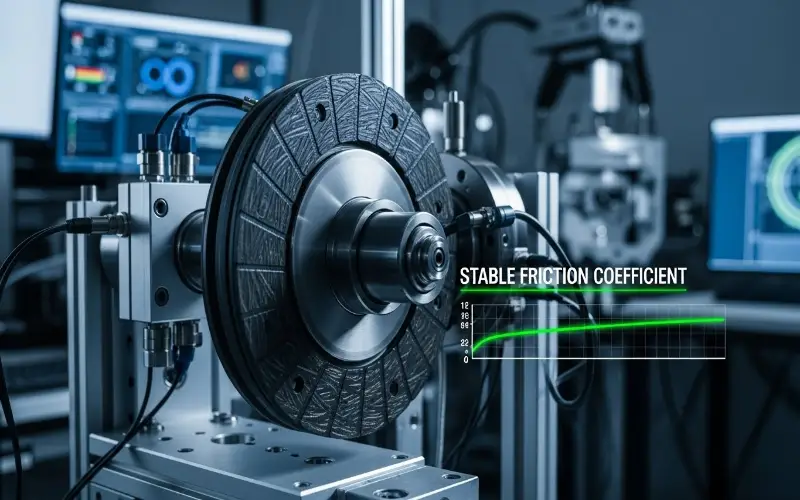
How We Measure It: Inside the Kukauto Testing Lab
We don’t rely on raw material supplier data; we validate every batch in-house.
The Chase Machine Test (SAE J661)
This is the global standard for rating friction materials. A 1-inch square sample is pressed against a rotating drum under controlled heat steps. This test determines the Edge Codes printed on the product.
The Krauss Test
While Chase is a material test, Krauss is a functional test. It simulates “Stop-and-Go” traffic cycles, measuring how the friction coefficient behaves under repetitive stress and fatigue.
Sourcing Guide: Interpreting Friction Codes (Edge Codes)
Look at the edge of any quality brake or clutch lining. You will see a code like “FF” or “GG”. This is not a random batch number; it is the SAE J661 Friction Rating. Knowing this empowers you to audit suppliers instantly.

| Code Letter | Friction Coefficient (μ) | Performance Level |
|---|---|---|
| E | 0.25 – 0.35 | Low friction (Light duty only) |
| F | 0.35 – 0.45 | Standard Automotive / Light Truck |
| G | 0.45 – 0.55 | Heavy Duty / High Performance (Kukauto Standard) |
| H | > 0.55 | Racing / Specialized Industrial |
Decoding the Two Letters (e.g., “GF”)
- First Letter: Normal Friction Coefficient (Cold/Warm performance).
- Second Letter: Hot Friction Coefficient (Fade performance).
Buyer Tip: If a supplier claims “Heavy Duty” but the code says “FE”, they are lying. The “E” means the grip drops significantly when hot. Always look for “FF”, “FG”, or “GG” for commercial vehicles.
Troubleshooting: Friction-Related Failures
Slippage
Cause: Glazed surface where μ dropped below 0.25. Often due to oil contamination or severe overheating (driver riding the pedal).
Judder / Chatter
Cause: Material with an overly aggressive μ (Stick-Slip phenomenon) or uneven resin distribution on the disc surface.
Dragging
Cause: Thermal expansion of the friction material. Cheap materials swell when hot, reducing the clearance gap.
Why Kukauto’s Friction Formula Stands Out
At Kukauto, we treat friction engineering as a science, not a commodity.
Our Proprietary Formula
We use a high-copper, high-kevlar blend that balances longevity with grip. Our materials are engineered to be “rotor friendly,” minimizing wear on your flywheel.
<1% Fade Rate
In lab tests up to 300°C, Kukauto facings maintain 99% of their original torque capacity, ensuring consistent performance in the toughest conditions.
FAQ About Friction Coefficient
Conclusion
In the heavy-duty aftermarket, a clutch is only as good as its friction material. While dimensions and fitment are important, the Friction Coefficient is the true measure of performance.
Final Advice for Procurement Managers: Stop buying based on weight or price alone. Start asking for Friction Test Reports. Demand to see the “Mu-Curve.” A stable curve protects your vehicles, saves fuel, and ultimately protects your reputation.
Don’t Guess on Quality. Verify It.
Looking for stable, high-performance clutch kits? Request our full Lab Test Report and a Free Sample Kit today to see the Kukauto difference.