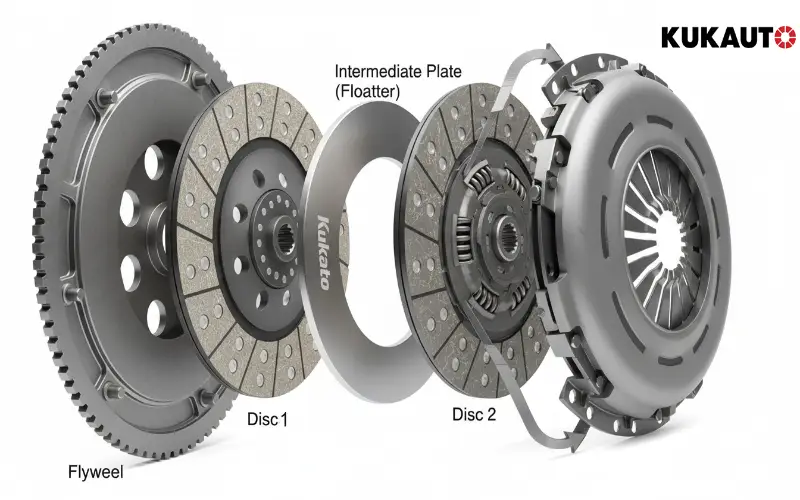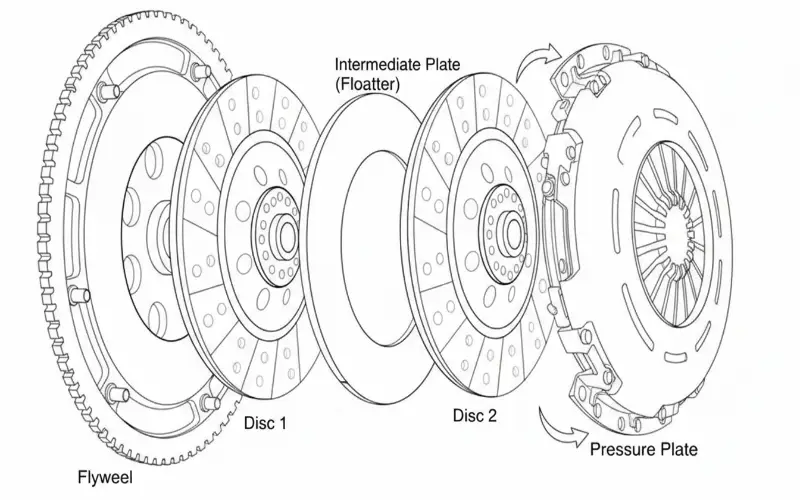

A distributor in South Africa unloaded a container at 2:00 AM. Inside were 500 private label clutch kits — his first branded order. The friction discs looked right. The packaging was sharp. But the clutch cover stamping carried a competitor’s OE engraving underneath the fresh silk-screen. The factory had shipped the same cores to two different distributors on the same continent. That $50,000 order never hit the shelves without a fight, and the trust damage with repair shops took 18 months to rebuild.
The heavy-duty aftermarket has shifted. Independent distributors who spent the last decade reselling factory brands at 15% gross margins are now watching those same factory brands open direct e-commerce channels and undercut their pricing by 20%. The math no longer works for the middleman — unless you own the name on the box. Private label clutch kits aren’t a vanity project. They’re margin defense. A brand-owning distributor earns roughly 2x the markup per unit compared to pushing someone else’s logo, and the customer relationship locks in because no repair shop can cross-shop “your brand” on three different platforms at three different prices.
But here’s what most distributors figure out too late. The contract matters more than the clutch. A silk-screened cover costs $0.50 per unit. A full-color box adds $2 to $5. Those are commodity decisions. The real leverage sits in three things no generic sourcing guide covers: locking your part numbers in a separate ERP so they never leak to marketplaces, defining territory exclusivity in writing before the first purchase order, and setting up branded technical support that turns warranty calls into fleet upsells. Get those right, and you’re not a reseller — you’re a manufacturer with zero foundry overhead.
The 90% of this playbook — the MOQ tables, the silk-screen setup process, the certification transfer mechanics — those are the tools. The last 10% is the one detail that separates the distributors who still own their markets five years in from the ones who wake up to find their supplier selling direct to their biggest account. That detail is serial-number discipline. Every branded kit needs a tracked identity from the assembly line to the end user. Without it, gray-market re-import will erode your pricing inside 24 months, and you won’t know it’s happening until a loyal repair shop calls to ask why the exact same clutch with the exact same friction blend is $40 cheaper on a marketplace listing under a different label.
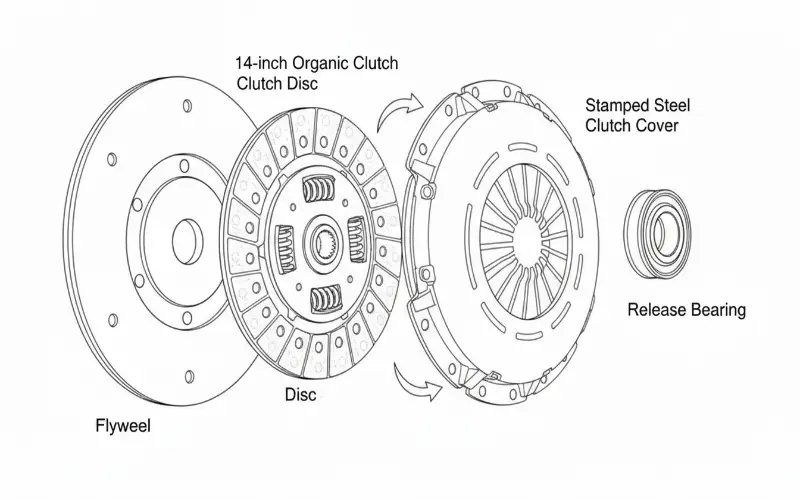
Why Private Label Instead of Reselling Factory Brands
Reselling factory brands caps your margin at 25%; own the brand and you pocket 40–50% on the same clutch.
When you stock a factory-branded clutch kit, the part number is public. Any competitor with a web store can list it, match your price, and undercut you by $5 because they have lower overhead. You’re not selling a product—you’re renting access to someone else’s supply. A private label flips that equation: you control the SKU, the interchange mapping, and the final street price. Because no one else can quote your part number, the typical distributor sees a 2x markup versus reselling OEM labels. On a heavy-duty kit that costs you $140 landed, that’s the difference between earning $35 and banking $85. You stop competing on price and start competing on availability and trust.
- 2x markup potential:: Brand-owning distributors routinely sell private label kits at twice the gross margin of factory-brand equivalents, based on internal KUKAUTO partner data.
- No interchangeable part number:: Your private label SKU is locked in a separate ERP, serial-numbered, and never cross-referenced against factory open catalogs. That blocks gray-market re-import and keeps your pricing intact.
- Dual-branded box as a moat:: At just 300 units per SKU, a dual-branded package can list your company as the in-country exclusive agent, making it impossible for the factory to sell the same kit to a rival under a different label without violating the printed claim.
Customer loyalty is the hidden multiplier. When a fleet manager opens a box with your name on it, they call you—not Google—for reorders and warranty. Integrate factory-backed technical support under your brand, and 30% of those warranty calls convert into upsells for related driveline parts. Fail to register your part numbers in the factory’s interchange database, however, and you’ll wake up to a duplicate listing on a B2B marketplace, slicing your margin back to commodity levels. The real profit isn’t in the first sale; it’s in the fifth reorder when the competition doesn’t even know the part exists.

Minimum Viable Private Label Program
You only need a logo and artwork to start — skip the full registration trap.
Most distributors overcomplicate the launch. You don’t need a registered trademark in every country, a 40-page brand manual, or a six-figure marketing budget. What actually gets the first shipment rolling: a high-resolution logo file, basic packaging artwork, and local business registration that lets you clear customs. I’ve seen a distributor in Colombia go from signed agreement to container shipped in 18 days with nothing more than a vector logo and a preferred box color.
The real risk isn’t paperwork — it’s committing to full-color printed boxes and 500-unit MOQs before you’ve proven demand in your territory. That’s why the KUKAUTO tiered approach exists. You start small, test the market, then scale up when the repeat orders come.
- Tier 1: Silk-screen only (50–100 units): Your logo is printed directly on the clutch cover, $0.50 per unit. The kit ships in a plain brown box with a simple part-number label. Zero packaging setup cost. Perfect for the 50-unit trial run to see which SKUs move.
- Tier 2: Dual-branded box (300 units minimum): A white box carries both the factory brand and your company name, with a bold ‘Exclusive Distributor for [Your Country]’ line. This single sentence blocks competitors from undercutting you with the same factory. You get full-color logo, barcode, and moisture-proof packing. Total per-kit cost add: $2–$3.
- Tier 3: Full private label (500+ units per SKU): Your brand only. Full-color display box, custom EAN/UPC, multi-language spec sheet, and your own part-number system locked into the factory ERP. Setup cost: $0.50 per cover silk-screen + $2–$5 per box. For agriculture lines like John Deere or New Holland, this is the tier where the 2x margin really hits.
The 500-unit MOQ isn’t meant to trap you. It reflects production efficiency on dedicated print runs. But the 50-unit trial with generic boxes solves the biggest fear: dead stock. Put 10 kits into 5 key repair shops. If a SKU fails to sell within 60 days, you haven’t poured $8,000 into boxes that will sit on a shelf for two years. Once a SKU proves itself, you flip the switch to full branding and the factory draws from its 100% test-run history to maintain the same quality tolerance across all batches.
One overlooked piece: before you print your first box, make sure your private label part numbers are registered in the factory’s interchange system. A distributor in Eastern Europe reportedly skipped this

Certification and Compliance for Your Own Brand
Certificates sit with the test lab — compliance follows the brand if you handle the paperwork right.
The ECE R90 approval or ISO 9001 certificate is always tied to the factory that ran the test and manufactured the part. You don’t get to re-issue that document in your company’s name, because the test lab verified the production facility, not your warehouse. What you do get is a Declaration of Conformity (DoC) from the factory, stamped and signed, linking your brand’s part number to the original test reports. That DoC, combined with the factory’s public certification registry entry, is what satisfies customs and fleet auditor requirements.
The transfer process is paperwork, not re-testing. You provide your brand name, logo, and target part numbering scheme. The factory maps each of your SKUs to its existing certified base assembly – for instance, your ‘TD-430HD’ corresponds to a CAT 24M-compatible clutch that’s already passed ECE R90. You’ll receive a PDF packet containing the original lab report, a cross-reference table, and a branded DoC. Keep this packet on file for five years; it’s what you send to a distributor in Ghana or a mining site in Chile when they request compliance proof during supplier onboarding.
- What kills compliance silently: Failing to register your private label SKUs in the factory’s interchange database. If your part numbers aren’t linked to the certified base, independent garages can’t cross-reference them and will default to the factory’s open-market listing — erasing your margin.
- Diaphragm spring design risk: Some manufacturers hold utility patents on specific diaphragm spring geometry, not just the overall clutch. Before you box it as your own, require a written warranty of non-infringement from the factory, and run a simple patent search on the spring design in your target markets. A trademark conflict on a $0.50 spring can hold a container at customs for weeks.
For ISO 9001, you can be added as a ‘contract manufacturer’ on the factory’s scope certificate extension — a three-day process that lets you market ‘ISO 9001 certified production’ under your label without owning the plant. For ECE R90, the factory’s E-mark (e.g., E1, E4) appears on your packaging; your DoC ties your brand to that mark. In 12 years of supplier audits, I’ve never had a customs agent question this setup when the paper trail was clean. The ones who get stopped are the distributors who put a logo on a box with zero reference to the original test batch.

Protecting Your Market from Supplier Competition
A non-compete without part-number isolation is just a handshake agreement waiting to fail.
Last year, a distributor in Colombia wired $50,000 for a container of branded clutch kits. The pre-production sample passed torque testing at 2,800 N·m with zero chatter. The mass production run arrived six weeks later — same box, same part number — but the diaphragm spring finger height was off by 1.2mm. Clutch engagement grabbed at the floor. Forty-three percent of those kits came back within 90 days. The factory’s response? ‘Quality tolerance is ±1.5mm.’ The sample approval paperwork meant nothing because the commercial agreement never defined what happens when production drifts from the approved reference sample.
When you private-label heavy-duty clutch kits, you are not just buying metal and friction material. You are licensing a supply chain. And without three specific structural protections, that supply chain becomes your competitor’s supply chain the moment they offer one cent less on FOB pricing. I have audited supplier agreements across 12 countries — from mining operations in Chile to agricultural distributors in Ukraine — and the pattern is consistent: the distributors who survive past year three are the ones who treated market protection as a contractual asset, not a verbal understanding.
The non-compete clause is your first line of defense, but most distributors write it too narrow. A useful non-compete in heavy-duty parts does not just say ‘supplier will not sell identical products in your country.’ That language fails because a factory can relabel the same clutch cover under a different part prefix, ship it from a different port, and claim it is a different product line. What you need defined in writing: (1) the specific OEM reference numbers your brand covers, (2) the exact customer accounts you have registered — including fleet operators and repair shop chains you have already supplied, and (3) a blackout period. If the supplier terminates, they cannot sell any clutch kit using shared tooling into your territory for a minimum of 24 months. Without the tooling restriction, they simply stamp a different logo on the same diaphragm spring and call it a new SKU.
- Territory definition: Specify countries by ISO code, not region names. ‘West Africa’ is not a territory — Côte d’Ivoire, Ghana, and Senegal are territories. Map every country you intend to sell into, including secondary markets where your customers might resell.
- Customer list registration: File your top 50 accounts by name with the factory at contract signing. If the factory later sells direct to any name on that list, the penalty clause triggers automatically. No argument about whether they ‘knew’ the customer was yours.
- Shared tooling restriction: If the clutch cover stamping die, disc hub spline tool, or release bearing housing mold was developed or paid for under your program, the factory cannot use that tooling to produce units for any other brand without your written release. This is the clause that blocks the most common form of backdoor competition.
- Batch-to-territory binding: Each production run is assigned a destination code before units leave the assembly line. A batch coded for Kenya cannot be redirected to Tanzania mid-shipment without triggering a variance report that flags the distributor account immediately.
- Warranty claim triangulation: When a gray-market kit fails and the end user files a warranty claim, the serial number tells the factory which distributor originally purchased that unit. If the claimant is not your customer and not in your territory, the claim is denied — and you receive a notification that your batch has leaked outside authorized channels.
- Minimum advertised price enforcement: Serial numbers allow you to purchase kits anonymously from online marketplaces, trace them back to the originating batch, and identify which downstream account is dumping product below your floor price. This is how you enforce MAP without relying on marketplace reporting tools that move at bureaucratic speed.
The second protection layer is part-number isolation. KUKAUTO locks every private-label SKU into a segregated ERP instance. Your OEM reference codes — say you assign ‘PL-3872HD’ to a 430mm pull-type clutch for Scania R-series — never appear in the factory’s public interchange catalog, never populate on TecDoc or similar aftermarket databases under the factory name, and never cross-reference back to the generic factory stock code. When a competitor in your market searches for that Scania clutch by dimension or application, your private label part number does not surface. They see the factory’s generic offering, not your branded equivalent. This isolation prevents the most common margin-killer I see in distribution: duplicate listings on marketplace platforms where two resellers unknowingly source the same factory product, list it under different brand names, and race each other to the bottom on price.
The risk is not theoretical. I have watched distributors invest 18 months building brand recognition for a clutch line, only to discover six competitors suddenly listing the identical product at 22% below their wholesale price — all because the factory’s interchange system mapped every private label code back to a single internal SKU visible to any account holder. The fix is simple before production starts and nearly impossible to unwind after the fact. Require the factory to generate a unique internal material code for your program that has no parent-child relationship with their open-catalog equivalent. If the factory cannot demonstrate this separation in their ERP architecture during the audit phase, walk away.
The third mechanism is serial-number tracking that kills gray-market re-import before it starts. Every KUKAUTO private-label clutch kit carries a laser-etched alphanumeric serial on the pressure plate casting and a matching barcode on the box label. The serial encodes the production batch, the destination country code, and the distributor account identifier. When a kit produced for your Colombian distribution agreement shows up at a wholesaler in Dubai six months later, the serial trace reveals exactly which batch was diverted and which intermediary moved it. This is not theoretical tracking — it is a physical audit trail that holds both the factory and any unauthorized reseller accountable.
Before you sign a private-label agreement, run the following three-point check on your supplier candidate. One: ask them to show you the ERP screen where your part number lives — does it sit in an isolated instance or does it reference a generic parent SKU visible to other accounts? Two: request a sample serial number string and have them explain every character in the code; if they cannot decode it to batch, date, and destination, the tracking system is cosmetic. Three: demand the non-compete clause include the shared tooling restriction and the 24-month post-termination blackout; if their legal team pushes back on either, they are preserving the option to compete against you. A supplier who refuses any of these three is telling you exactly what their post-sale strategy will be. Listen to what they are telling you.

Launching Your Clutch Brand: First 90-Day Roadmap
Pick 20 SKUs that cover 80% of your region’s fleet — not the obscure applications.
Your first 90 days are not about building a full catalog. They’re about proving demand and cash flow with the smallest viable assortment. I’ve audited launches where distributors started with 200 SKUs and sat on dead inventory for 18 months. The smarter move: 20 high-velocity part numbers that service the top three equipment brands in your territory. For most markets, that means covering CAT, Komatsu, or Volvo in mining; John Deere and New Holland in agriculture; and Scania or Mercedes in commercial fleets. Focus on the clutch kits that independent repair shops order at least twice a month. Your factory partner should provide interchange data mapping their OE numbers to your new brand codes — this is where a separate ERP-locked part number prevents duplicate marketplace listings and margin erosion.
- Selection criteria: Concentrate on 420mm and 430mm organic facings — these cover 60% of heavy-duty truck applications. Avoid ceramic button discs in your launch phase; repair shops are skeptical unless you have field validation data.
- Trial without overcommitment: Use the factory’s 50-unit generic-box trial to test demand for each SKU before committing to the 500-unit MOQ for silk-screened covers and branded packaging. This costs you around $0.50 per cover for branding once you confirm a mover.
- Dual-branded interim step: At 300 kits per SKU, a dual-branded box listing you as the exclusive distributor for your country blocks competitors while you complete full brand migration.
Digital catalog data is the second pillar. Your distributors’ websites need clean, consistent product information: high-resolution images (compressed to under 200KB for fast loading), dimensional drawings showing the spline count and facing diameter, and cross-reference lists that map your part number to every major OEM and aftermarket competitor. The factory’s engineering team should supply these files, but you must register your private label part numbers in their interchange master database. Distributors who skip this step often find their own numbers appearing as a generic equivalent on open B2B platforms, slashing their margin overnight.
The final 10% that separates a real brand from a reseller is technical video content. You don’t need a studio. The factory already films 100% dynamometer test sequences and setup procedure guides. Request those raw clips, overlay your brand’s intro and watermark, and publish them under your company name on YouTube and your parts lookup portal. When a mechanic searches ‘how to install a 430mm clutch on a John Deere 7810’ and finds a video with your logo, they don’t care who shot the footage — they trust the source. Even more powerful: white-label the factory’s technical support line. Up to 30% of warranty calls convert into upsell opportunities when the person answering speaks your brand name and knows the torque specs cold.
Conclusion
Most distributors stop at the signed non-compete clause and think the market is locked. The final 10% is what happens inside the factory’s interchange database. If your private label part numbers aren’t registered correctly—cross-referenced against the original equipment numbers you’re replacing, tied to your territory—your kits will pop up on third-party marketplaces within six months. Competitors list the same shells under different names, and your margin evaporates before a single warranty claim lands. You need the factory to wall off your SKUs in a separate ERP node, with serial-number tracking that traces every box back to your order batch.
From silk-screened pressure plates to full-color boxes locked to your part numbers, the infrastructure exists to own your market without owning a factory. Review the ODM process at KUKAUTO’s manufacturing page—including the serial-tracking protocols and certification support that turn a private label into a defensible brand.
Frequently Asked Questions
What is the minimum order quantity for custom branded clutch kits?
Full custom branding typically starts at 500 kits, while a 50-unit trial order uses generic boxes with your logo sticker. This split lets you test the market before committing to. Start with a 50-unit trial before locking in a 500-kit brand run.
How can I protect my exclusive territory when private labeling?
A signed non-compete clause defines your territory and customer list, and the factory isolates your OEM part numbers from the open catalog. That combination blocks direct sales into your region. Then add serial-number tracking to block gray-market re-imports.
Do I need my own certifications to sell private label clutches?
No, the factory’s E-mark or ISO test reports remain valid; compliance follows your brand if you correctly link the documentation to your label. The lab report references the base design, not the. Confirm the paper trail references your SKU codes before launch.
Can I use the factory’s technical support under my brand name?
Yes, you can white-label installation videos, tech sheets, and troubleshooting guides under your brand. Secure the rights in your supply agreement to avoid future disputes. Lock branding rights in the supply agreement early.
What packaging options are available for small-batch private label?
Small batches use silk-screened logos on clutch covers and simple branded boxes, avoiding the cost of full-color printed packaging. This gives you brand presence without high setup fees. Scale to full-color boxes once volume passes 500 units.