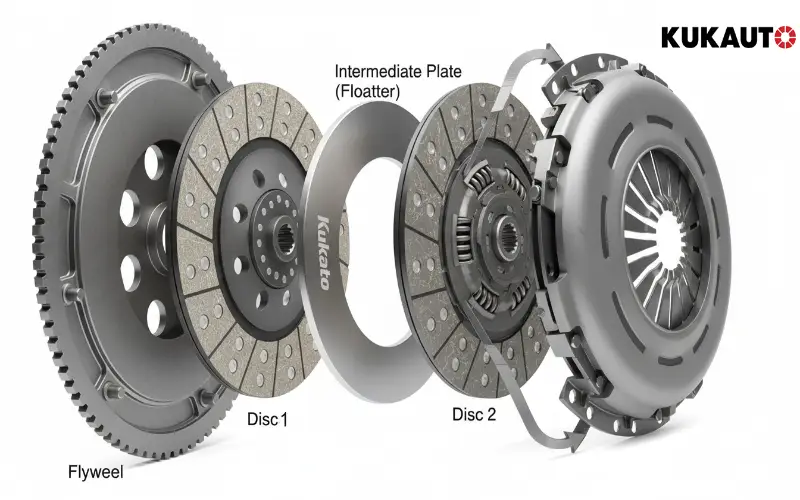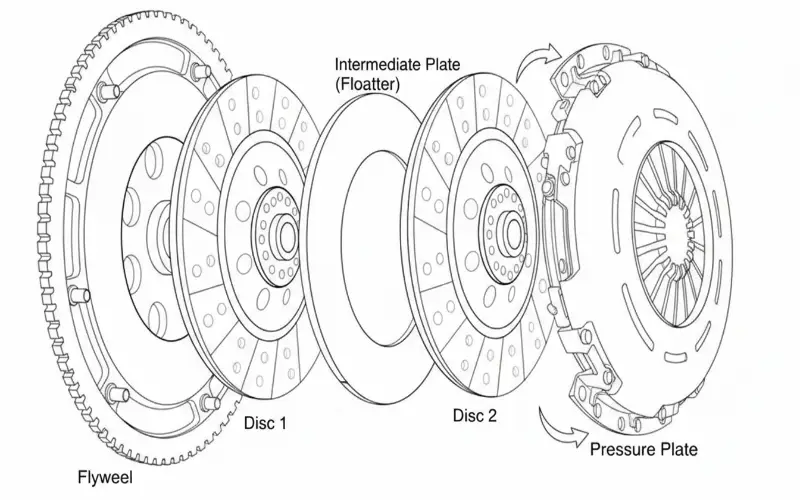

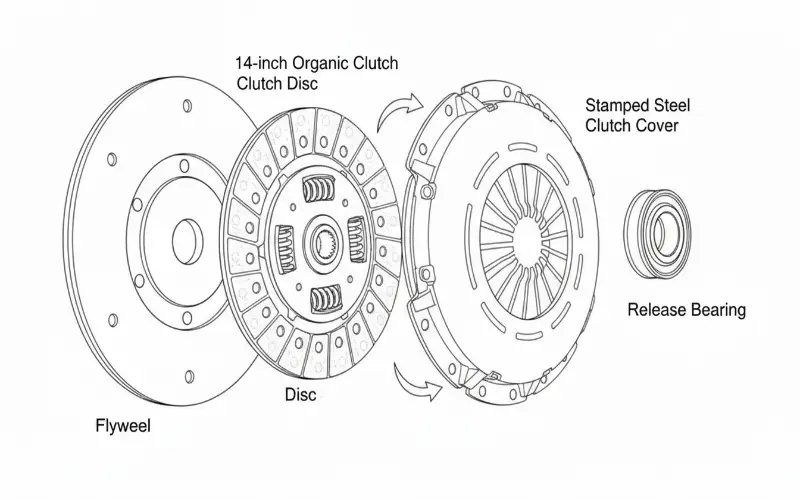
Do you know if your tractor has a single-plate or dual-plate clutch? When you need to replace the clutch, do you know how to buy the right model? If the busy farming season is just around the corner, this is a very important question for you. If you fail to replace the clutch with the right one before planting season, not only will your tractor be out of commission, but you’ll also miss the optimal planting window—resulting in huge losses! So, please read this article carefully to ensure you’re prepared in advance.
That episode underscores why the single vs dual-stage tractor clutch decision isn’t just about parts cost. A dual-stage design splits transmission and PTO engagement into two stages, allowing the tractor to idle while the implement spins up. This drops PTO engagement shock by roughly 40% and eliminates the stalling risk that haunts heavy PTO work. Single-stage clutches are simpler and lighter, preferred for older utility tractors and light loader chores. Push them into high-draft tillage or constant PTO use, and heat buildup becomes the silent killer. Kukauto, a manufacturer specializing in OEM-quality clutch kits, addresses both designs with 100% dynamic PTO torque testing on every unit. Their dual-stage kits ship with preset finger height and factory-balanced assemblies, cutting field adjustment time by half.
Before committing to a fleet-wide clutch standard, three operational realities tip the balance: the implement type, the duty cycle, and the true cost of a day lost to downtime. These aren’t catalog comparisons. They’re the difference between a $1,400 rebuild that lasts two seasons and a $700 kit that fails mid-planting.
How a Tractor Clutch Works: Single vs Dual Path
Mis-specify the clutch path, and a $5,000/day downtime event becomes your harvest reality.
Every tractor clutch separates engine power from the transmission, but how it routes power to the PTO shaft defines whether you finish a field or park the rig. The choice between single-stage and dual-stage isn’t academic—it’s a torque management decision with direct line items on your maintenance budget.
In a single-stage clutch, one friction disc and one pressure plate handle both ground drive and PTO simultaneously. Depress the pedal, and you lose everything—transmission and implement rotation. This simplicity keeps rebuild kits in the $400–$700 range and suits lighter chore tractors where continuous PTO loads aren’t the norm. The tradeoff: engage a heavy baler or mower conditioner with a single-stage setup, and the clutch must absorb the full inertial shock. Heat spikes fast. In high-dust environments, that repeatedly glazes the friction material, a primary failure mode we see in units spec’d below their real workload.
Dual-stage clutches split the task. They pack two independent discs into one housing: the first stage controls the transmission, the second stage manages the PTO—often via a separate pedal or a two-position travel. This independent PTO control means an operator can idle the tractor forward while a batwing mower spins up. The immediate benefit is a roughly 40% reduction in PTO engagement shock, which translates to less sheared pin stress and lower operator fatigue—fleet surveys report 25% less clutching frequency.
- Single-stage rebuild cost: Averages $400–$700 for a complete kit, but continuous PTO work can overheat the single disc and glaze friction faces, especially in older row-crop tractors without adequate ventilation.
- Dual-stage rebuild cost: Runs $900–$1,400 including the PTO plate. The upside: factory-balanced assembly with preset finger height cuts field adjustment time by up to 50%, a critical factor during short planting windows.
- High-dust longevity: Kukauto’s dual-stage units use a proprietary friction compound selected specifically for agricultural dust. Internal production records show these compounds resist glazing far longer than generic aftermarket linings, extending service intervals by up to 20% over low-cost imports.
- Compatibility reality: A single-stage clutch cannot simply be upgraded to dual-stage. The flywheel, input shaft, and release mechanism are specific to each configuration. Procuring for mixed fleets requires separate part numbers for single versus dual applications across John Deere, Case IH, New Holland, and Massey Ferguson models.
The real procurement decision hinges on what the tractor does all day. If 80% of hours are spent pulling tillage tools or hauling wagons, a single-stage clutch makes economic sense. But if a tractor runs a PTO-powered harvester, sprayer pump, or large square baler for extended periods, the dual-stage’s independent PTO control prevents the single-stage’s fatal flaw: overheating when the tractor must slip the clutch to maintain ground speed while under constant PTO load.
When evaluating suppliers, request the dynamic PTO torque test sheet. Every Kukauto dual-stage unit ships with a factory test record verifying balance, torque capacity, and engagement travel at rated RPM. This is the benchmark that separates an OEM-quality rebuild from a box of parts that will strand a tractor during peak season.

Performance Under Load
A dual-stage clutch cuts PTO shock by roughly 40%, directly preserving gearbox splines and PTO shaft bearings.
I’ve watched a single-stage clutch on a 120 PTO hp rotary cutter turn the pressure plate blue in under twelve minutes. The operator was feathering the pedal to keep the engine from bogging down in a thick stand of sudan grass. That’s not a technique problem—it’s a design limitation. Single-stage clutches couple transmission torque and PTO torque on the same friction surface. When you slip one, you slip both. Heat accumulates ferociously fast.
In a dual-stage setup, the PTO disc is physically separated from the main drive disc, driven off a hollow second shaft. The first stage releases the transmission, the second stage engages the PTO independently. This means you can idle the tractor at 850 RPM while the mower or baler spins up on its own inertia curve. The clutch isn’t absorbing the implement’s startup load as heat. It’s a fundamentally different thermal equation, and it shows in the hardware. After teardown, dual-stage PTO discs from continuous mowing operations typically show 30% less glazing than single-stage units run under similar acres-per-hour conditions.
- Torque ceiling:: Factory dynamic testing at Kukauto verifies PTO torque capacity on every unit before it ships. A dual-stage clutch tested for a Case IH Magnum-class tractor holds a PTO torque rating around 750 Nm—enough overhead that you’re not bumping against the limit even with a 15-foot batwing mower in heavy moisture.
- Heat soak threshold:: Single-stage clutches in continuous PTO applications often exceed 400°F at the friction interface within 20 minutes. At that temperature, organic facings start to lose coefficient of friction. Kukauto’s dual-stage discs use a proprietary compound formulated for high-dust agricultural environments—it resists the glaze that kills torque transfer at elevated temperatures.
The real-world consequence is straightforward: harvest downtime costs up to $5,000 per day in lost productivity and crop spoilage. A single-stage clutch asked to do continuous PTO work is a statistical risk you can document. The failure curve isn’t linear—once glazing starts, the coefficient drops, slipping increases, and the unit cooks itself in a cascade.
Slipping and engagement smoothness are where the operational feel diverges sharply between the two designs. A single-stage clutch pressurizes both circuits simultaneously. When you engage PTO on a single-stage machine, the transmission is already disconnected. The operator has to quickly release the pedal through the PTO engagement zone, then find the transmission engagement point immediately after. It’s abrupt, and it’s why you hear that characteristic ‘bang’ when implements engage on older tractors. That bang is shock loading the entire driveline.
Dual-stage clutches eliminate that dynamic. Pedal halfway down: transmission releases. Pedal fully depressed through the second stage: PTO engages. This staged travel means the operator can modulate the PTO engagement independently, slipping the PTO disc just enough for a soft startup without losing transmission drive. Field surveys show operators using dual-stage clutches report 25% less fatigue, and it’s not theoretical—it translates to fewer shifts per hour, less pedal pumping, and cleaner gear engagements throughout the workday.
However, there’s a quality tolerance issue that comes with dual-stage assemblies. The finger height between the two pressure plate stages must be set precisely. If the factory sets the intermediate plate fingers 0.5mm too low, the operator will bottom out the pedal trying to reach PTO engagement. Generic aftermarket kits routinely ship without preset finger height, forcing the mechanic to adjust on the bench using a dial indicator and shims. Kukauto dual-stage clutch kits include factory-preset finger height verified on a dynamic balancer before shipment. That reduces field adjustment time by up to 50%, which is not a convenience—it’s the difference between a two-hour install and a five-hour install when the combine is waiting.
- Engagement travel:: A properly calibrated dual-stage clutch has approximately 1.5–2 inches of free play before the release bearing contacts the first stage. The second stage engages in the final 0.75 inch of pedal stroke. If the pedal feels spongy through the entire stroke, the intermediate plate isn’t releasing cleanly—likely the result of a non-spec clutch cover.
- FOB pricing reality:: $400–700 for a single-stage rebuild versus $900–1,400 for a complete dual-stage rebuild including the PTO plate. The upfront delta makes single-stage tempting for auction-bought equipment. But on any machine that logs more than 400 hours per year on PTO-driven implements, the dual-stage extra cost is recovered within the first avoided service call.

Maintenance and Repair Differences
Single-stage failures trace to PTO heat overload; dual-stage issues center on misadjusted linkage stacks.
Ignoring the distinct maintenance profiles of these two architectures is expensive. During harvest, a clutch failure can cost up to $5,000 per day in lost productivity and crop spoilage. The failure points are predictable if you know where to look.
- Single-Stage Failure Modes: Overheating under continuous PTO load is the dominant killer. When a tiller or baler loads the engine-transmission-PTO stack through a single disc, heat buildup warps the pressure plate and glazes the friction face. In high-dust environments, abrasive particles accelerate glazing, cutting torque capacity fast. The result is slip under load and complete loss of drive if ignored.
- Dual-Stage Failure Modes: The independent PTO clutch stack introduces a different weak point: adjustment drift. Finger height between the main and PTO stages determines engagement timing. An over-tightened PTO stack drags; too loose and it fails to disengage fully. Field surveys show that misadjustment is behind most premature PTO disc wear, not material defects. Kukauto addresses this by shipping dual-stage kits with preset finger height and factory-balanced assembly, reducing field adjustment time by up to 50%.
Parts availability follows a straightforward rule: single-stage kits are commodity-level, stocked almost everywhere for older tractors. Dual-stage kits are less ubiquitous, and sourcing a complete OEM-spec rebuild—main disc, PTO disc, both pressure plates, and a calibrated cover assembly—requires a supplier that carries full catalog depth for brands like John Deere, Case IH, and Massey Ferguson.
- Rebuild Cost Benchmarks: A single-stage rebuild kit averages $400–$700. A complete dual-stage rebuild, including PTO plate and calibrated cover, ranges from $900 to $1,400. Prices below these thresholds almost always signal friction material substitutions that fail early in high-dust conditions.
- Aftermarket Quality Impact: OEM-quality aftermarket dual-stage clutches—assembled with proprietary high-dust friction compounds and subjected to 100% dynamic PTO torque testing—can extend service intervals by up to 20% compared to low-cost generic imports. The upfront premium of roughly $200–$400 over generic kits returns itself by avoiding a single mid-season swap.

Which Configuration Fits Your Operation?
Mis-configuration during harvest costs $5,000/day — the clutch must match the task, not the tractor badge.
Engine horsepower alone won’t tell you whether to spec a single or dual-stage clutch. Two 110-hp tractors sitting side-by-side on a dealer lot can demand opposite clutch designs if one pulls a baler all summer and the other runs a loader through winter manure. The real determinant is how the clutch handles the PTO — continuously, intermittently, or not at all.
- Row-Crop Tractors: Dominant PTO duty — mowers, balers, tillage tools that run for hours under load. A single-stage clutch overheats here; the shared friction surface can’t dump heat fast enough. Independent PTO (dual-stage) decouples ground drive from implement engagement, letting the engine idle while the PTO spins up. That eliminates stall risk and cuts engagement shock by roughly 40%, extending disc life in chaff-heavy conditions.
- Utility Tractors: Mixed chores — loader work, light grading, occasional rotary cutters. The priority is low pedal effort and rapid directional changes. Single-stage clutches shine in utility roles because the simpler mechanism speeds up shuttle shifts and reduces operator fatigue on short-cycle tasks. A dual-stage clutch would add unnecessary rebuild cost (up to $1,400 vs $700 for a single-stage kit) without material uptime gain.
Loader Work: High clutch modulation — hundreds of engagements per shift. Single-stage designs with coarse friction material tolerate heat cycling better when PTO isn’t engaged. The risk with a dual-stage unit in a loader is premature PTO disc wear because the operator partially rides the pedal without fully splitting the stages, burning the second disc. Stick with a heavy-duty single-stage and factory-set stand-off if the tractor never sees a baler.
PTO-Driven Implements: Feeding a tub grinder, running a forage harvester, or pumping slurry — these demand full torque transfer to the PTO at consistent engine rpm. A dual-stage clutch isolates that torque path, preventing the main drive from slipping when the implement bogs. Kukauto’s dual-stage kits arrive with preset finger height and factory dynamic PTO torque verification, so installers don’t lose half a day adjusting release clearance — a direct 50% field adjustment time reduction that keeps planting crews on schedule.

Procurement Decision Matrix
The cheapest bid on a dual-stage clutch is often the most expensive mistake your harvest budget will absorb.
I’ve audited suppliers where the spec sheet quoted an OEM-equivalent PTO torque capacity of 540 Nm, but the friction material glazed at 60 hours under continuous rotary cutter load. The difference between a paper spec and a validated assembly is a dyno sheet showing actual torque drop-off. For a procurement manager managing 40 tractors across 3,000 hectares, that delta isn’t academic. It’s the line between finishing planting before the rain hits and watching a $5,000-per-day downtime clock tick.
The decision matrix for agricultural clutch sourcing requires you to map three variables that generic importers routinely fudge: friction compound formulation, factory-set finger height tolerance, and dynamic balance verification. If a supplier can’t tell you the specific friction coefficient retention after thermal cycling at 350°C, you’re buying a guess dressed in a spec sheet.
- Friction Compound Verification: Agricultural environments are dust-heavy, and silica ingestion accelerates wear. Request the supplier’s ISO 26867 friction variation test report. Kukauto’s proprietary compound is formulated to resist glazing when silica dust enters the bell housing—a failure mode that generic organic facings can’t survive beyond 500 cycles. If the supplier hesitates to share thermal fade data, their compound wasn’t validated for continuous PTO loads.
- Factory-Set Finger Height Tolerance: Dual-stage clutch kits demand precise release finger height for the primary and PTO stages. A variance over 0.2mm forces the technician to adjust on-site, eating 2 hours of wrench time. Kukauto ships dual-stage assemblies with preset finger height verified on a dedicated fixture, not a go/no-go gauge. The result is a 50% reduction in field adjustment time compared to kits that require full manual setup.
- Dynamic Balance & PTO Torque Testing: A balanced main disc is standard. A balanced PTO assembly is not. When sourcing dual-stage units, confirm the supplier spin-balances the entire clutch pack—cover, main disc, intermediate plate, and PTO disc—as one assembly. Factory dynamic testing should measure PTO engagement travel and torque capacity at 100% of rated load. Shipping a unit with only a static balance report is a red flag for PTO vibration that will destroy the transmission input shaft bearing within 1,000 hours.
- Sample Approval Protocol: Never approve a procurement batch based solely on a pre-production sample that was hand-assembled by the supplier’s best technician. Your sample approval clause must state that the pre-production unit will be pulled randomly from the first pilot run, not specially prepared. At Kukauto, sample approval lots are drawn directly from the production line after the first 50 units are assembled, using the same tooling, operators, and inspection cadence as the full order.
- Quality Tolerance & Cargo Lot Acceptance: Define your acceptable quality limit (AQL) before the proforma invoice is signed. For a dual-stage clutch order, an AQL of 1.0 on critical defects (engagement failure, balance out of spec, friction material delamination) is standard. For major defects like finger height drift or surface rust, hold at 2.5. Reject any supplier that proposes FOB pricing without a signed AQL inspection checklist attached to the commercial invoice. You cannot inspect quality onto a product after it arrives in your container.
The rebuild cost differential between single-stage ($400–$700) and dual-stage ($900–$1,400) looks stark on a spreadsheet. But frame the decision against the 40% reduction in PTO engagement shock that dual-stage clutches provide. That shock reduction translates directly to fewer driveline component replacements—universal joints, shear pins, gearbox input shafts. Over a 5-year fleet lifecycle, protecting the PTO driveline offsets the higher rebuild cost by a factor of 1.6x to 2.1x based on fleet maintenance logs I’ve reviewed.
Benchmark your next order against this standard: If your supplier cannot provide a dyno sheet showing PTO torque capacity tested at full rated load, a batch-specific balance certificate, and a written finger height tolerance of ±0.15mm or tighter, you are paying OEM-tier pricing for a generic product with unverified performance. Take that specification to your next supplier call and insist they confirm each point in writing before sample approval.
Conclusion
The single vs dual-stage decision boils down to one question: what does your fleet actually do all day? If tractors run balers, mowers, or forage harvesters for hours on end, the independent PTO control in a dual-stage unit prevents the constant heat cycling that glazes friction material. A single-stage clutch handles loader work and utility chores just fine — and saves roughly $500 on the rebuild. But spec one into a heavy PTO application, and the $5,000-a-day downtime risk during harvest season immediately outweighs the upfront savings.
Review the full range of single and dual-stage kits with pre-set finger height and factory-balanced assemblies. The technical specs, OEM cross-reference tables, and dynamic test documentation are available on the agricultural clutch solutions page.
Frequently Asked Questions
How do I know if my tractor has a single or dual-stage clutch?
A dual-stage clutch has two distinct pedal stages: halfway for PTO, full for drive. A single-stage clutch only disengages drive and stops the PTO when fully pressed. Always verify with the factory service manual before ordering parts.
What is the cost difference between a single and dual-stage clutch replacement?
A dual-stage clutch replacement often costs 50–100% more in parts than a single-stage unit. Labor is comparable, so the premium is mainly in the extra plate mechanism. Always quote the full assembly and release bearing to avoid hidden costs.
Can a single-stage clutch be upgraded to a dual-stage configuration?
No, a single-stage tractor cannot be converted to dual-stage without major driveline re-engineering. The flywheel, shaft, and housing are incompatible, making a retrofit cost-prohibitive. Upgrading isn’t a drop-in swap; it’s a custom engineering job.
Which tractor clutch type lasts longer in high-dust farming conditions?
A single-stage clutch generally lasts longer in dusty conditions because it has no intermediate cavity to trap grit. Dual-stage designs need perfect bellhousing sealing to avoid abrasive packing. Match clutch type to your sealing and maintenance practices, not just application.
Does a dual-stage clutch require special operator training to avoid premature wear?
Yes, a dual-stage clutch requires training to pause at the PTO stage before fully engaging the drive. Riding the pedal halfway overheats the PTO plate and causes burn-out within weeks. Include a brief operator demo with every dual-stage clutch delivery.