
If your clutch kit supplier quality checklist begins and ends with comparing FOB pricing and approving a pre-production sample, you’re already in trouble. Every distributor knows the playbook: collect three quotes, order a sample, pick the cheapest one that looks right. That exact process just burned a heavy-duty parts buyer—$50,000 in warranty work and fleet downtime, all because the pre-production sample passed with the right ceramic facings while the mass production run landed with organic material never meant for a mine site.
The real clutch kit supplier quality checklist doesn’t stop at sample approval or quality tolerance that looks fine on a single unit. It drills into clamping load verification test data, torque capacity testing standards, and a supplier’s willingness to share failure rate data from actual field use. Only 12% of aftermarket suppliers furnish certified clamping load figures—and when a 1% defect rate can cost an end user over $50,000 in a single event, skipping that step isn’t just a risk. It’s a margin killer that separates a credible supplier from a container full of surprises.
Material Specifications: Organic vs. Ceramic vs. Sintered Iron
Only 12% of suppliers provide the clamping load data you need to trust the material.
Did your last supplier send you a pre-production sample that gripped perfectly on the dyno, only to have the mass production batch glaze over in 300 hours? I’ve seen a $50K mining truck clutch order implode because the organic facings in the container didn’t match the sample approval torque curve. The root cause is almost never the specification on paper—it’s whether the supplier can hold the friction coefficient batch-to-batch under your actual load cycle.

- Organic facings (NAO): Maximum continuous temperature typically 250–300°C before the binder degrades. Acceptable for line-haul trucks where clutch engagements are infrequent and cool-down time is available. Inside a mine haul truck with frequent starts on a 10% grade, organic often fails before the first scheduled inspection. If your supplier can’t quote a μ stability range across 100–350°C, you’re buying a problem.
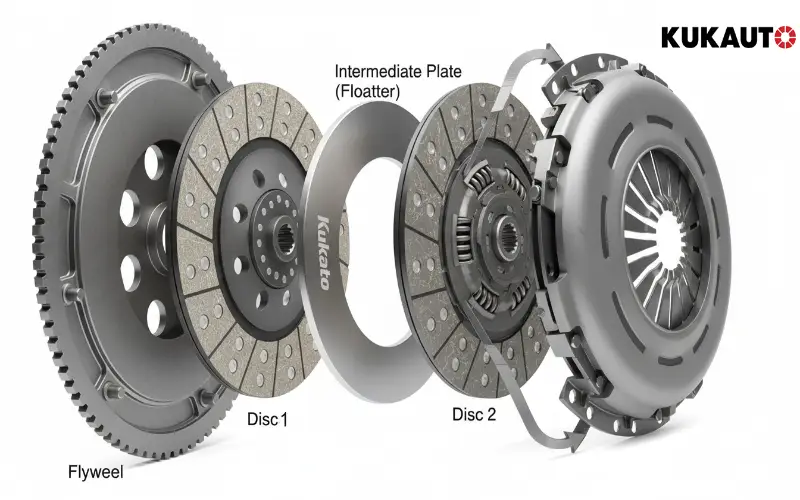
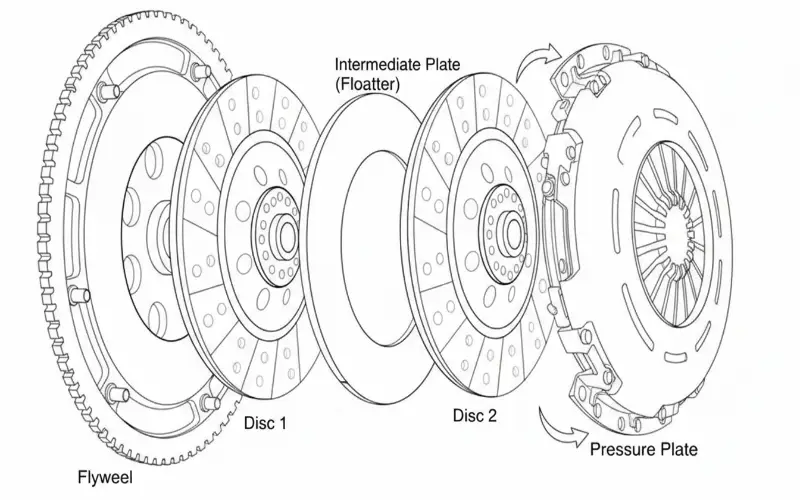
- Ceramic-metallic facings: Deliver higher torque capacity and handle 350–450°C operating ranges, but the thermal spike transfers directly into the pressure plate and flywheel. The clutch cover assembly clamping load must be verified within a tolerance band—typically ±5% of the design nominal—or the customer will see slippage under peak torque. Only ask for ceramic if your supplier provides that clamping load verification test data.
- Sintered iron facings: Routinely used in mining trucks, wheel loaders, and bulldozers where the clutch operates in silica dust and mud. Sintered iron tolerates continuous temperatures above 500°C and shock loads that would shear organic friction material off the disc core. The trade-off: it requires a higher release travel and a stiffer cover assembly. A 1% failure rate on a sintered iron clutch set that isn’t matched to the cover geometry costs $50,000+ in downtime and warranty replacement.
If your supplier can’t provide material certification sheets—not just a product catalog PDF—request a sample to an independent lab for SA
| Material Type | Composition | Performance Characteristics | Ideal Application | Risk & Cost Impact |
|---|---|---|---|---|
| Organic (NAO/Resin-Bonded) | Non-asbestos organic fibers, glass, rubber, and resin binders. | Smooth engagement; low NVH; max operating temp ~350°F (177°C); friction coefficient 0.30–0.40. | Light-to-medium commercial trucks; not rated for sustained high-torque mining or heavy agricultural use. | High glazing and rapid wear under frequent slip; 1% failure rate can cause $50K+ downtime; many ‘OEM quality’ aftermarket kits fall here. |
| Ceramic (Sintered Metallic-Ceramic) | Copper/iron base matrix blended with ceramic particles, bonded to steel backing. | Moderate engagement; temp tolerance up to 900°F (482°C); friction coefficient 0.38–0.50; low fade under repeated cycles. | Construction machinery, refuse trucks, on/off-highway vocational vehicles requiring moderate abuse resistance. | Aggressive on flywheel/mating surfaces; requires precise clamping load verification; only 12% of suppliers provide certified load data. |
| Sintered Iron (Full Metallic) | High-carbon compressed iron powder sintered at high heat; often with graphite or moly additives. | Maximum torque capacity; temp resistance up to 1200°F (649°C); friction coefficient 0.42–0.60; zero fade under extreme loads. | Mining haul trucks, heavy-duty tractors, 24/7 fleet operations; OEM-spec for severe-duty where organic facings fail. | Higher NVH and pedal effort; requires 100% factory-tested clamping load and torque capacity validation to ensure reliability. |
Testing Standards: Factory Tested vs. Lab Certified
A lab certificate on one sample proves nothing if the 500 units shipped were never tested.
I got the call six months after the containers landed. A mining fleet in Western Australia had three haul trucks down with burned clutches — same batch, same failure mode. The pre-production sample had passed a third-party lab certification with flying colors. Clamping load was spot-on. Torque capacity exceeded spec by 12%. The mass production run? Different story entirely. When we pulled random units from the warehouse and tested them on a load cell, clamping load was down 18% from the approved sample. That’s a $50,000 mistake hiding inside a lab report.

The distinction between factory tested and lab certified is the single most misunderstood concept in heavy-duty clutch procurement. Lab certified means a supplier sent one to three samples to an external facility — often the samples they hand-picked, pre-inspected, and personally delivered. Factory tested means every unit coming off the production line goes through a standardized verification rig before it gets a serial number. Only 12% of aftermarket suppliers actually do the second one. The rest sell you a lab report and hope you never audit the batch.
- Clamping Load Verification: This measures the force the pressure plate exerts on the friction disc — typically in Newtons or kilograms-force. For a heavy-duty mining truck clutch, you’re looking at 24,000 N to 32,000 N range depending on the application. A drop of 10% below spec doesn’t show up on a test drive. It shows up at 40,000 km when the truck loses pull on a 12% grade with 60 tonnes behind it.
- What Factory Testing Actually Looks Like: Every assembled clutch cover goes onto a pneumatic load cell rig. The machine compresses the diaphragm spring through its full stroke and records force at three critical points: release position, half-wear position, and full-engagement position. The data is plotted against the master specification curve. Units outside the ±5% tolerance band get rejected and reworked before they ever reach packaging.
- What Lab Certified Usually Means: The supplier sent two golden samples to an ISO 17025 lab. The lab tested them, issued a PDF, and that’s it. No batch traceability. No statistical sampling from the production population. No ongoing verification. When you’re distributing 2,000 units a year across 50 fleet customers, that PDF won’t save you from the warranty claims.
- Torque capacity testing follows the same pattern. A clutch rated at 2,100 Nm on a spec sheet was calculated from friction material coefficient, disc diameter, and clamping force — on paper. Put that same clutch on a dynamic torque test rig and spin it against a 2,100 Nm inertial load, and you find out in 45 seconds whether the math matches reality. Factory testing means the supplier runs this test on a statistical sample from every production batch — typically 1 in 50 units for standard production, or 100% for OEM contract runs bound for mining and quarry applications.
- Dynamic Torque Test Standard: The clutch is mounted on a dynamometer and cycled through engagement at full-rated torque. Temperature at the pressure plate surface is monitored. If the friction coefficient degrades more than 15% across 200 consecutive engagements, the batch fails. Ceramic and sintered iron facings should hold within 8% degradation across 500 cycles — organic facings in a mining application will fail this test before 100 cycles, which is exactly why they don’t belong there.
- The Safety Margin Question: Ask any supplier this: ‘What is your tested torque capacity as a multiple of the rated application torque?’ For mining trucks operating on grades above 10%, the answer needs to be at least 1.3x. For agricultural tractors pulling ground-engaging implements, 1.2x minimum. If the supplier can’t answer this question with batch-specific test data, they’re either not testing or they’re testing and not liking the results.
Here’s the benchmark I use on every supplier call: demand clamping load verification data for every unit in a production batch, not just the sample approval unit. The tolerance window should be ±5% from nominal. For torque capacity, require a dynamic test report showing the clutch handled at least 1.3x rated torque across 200 engagement cycles without friction coefficient degradation exceeding 10%. If the supplier can’t produce both, you’re not buying from a manufacturer — you’re buying from a packaging operation with a nice catalog. Write those two numbers down: ±5% on clamping load, 1.3x on torque capacity. They’re the difference between a clutch that outlasts the warranty period and one that puts your reputation on a flatbed tow truck.
Warranty Terms: What B2B Buyers Should Demand
If the warranty excludes the very conditions your clutches face daily, you’re self-insuring a $50,000 grenade.
You get the call 14 weeks after the shipment. A mining fleet manager in Western Australia just pulled one of your clutch kits off a haul truck with 1,200 hours on it. The friction material is glazed, the diaphragm finger heights are all over the place, and the release bearing has play. You submit the warranty claim. The factory rejects it in 48 hours, citing ‘heat discoloration excessive – abuse, not defect.’ The end user is screaming. You’re stuck holding a $4,200 replacement and a reputation hit that costs far more. This isn’t a hypothetical. It’s what happens when a distributor signs off on a warranty that protects the manufacturer, not the downstream chain.
- Clamping load drift beyond 8% of spec: Factory-tested values drop after heat cycles. If the warranty only covers ‘catastrophic breakage’ and ignores gradual performance decay, you’re constantly eating the labor cost of marginal clutches. Demand that any cover that loses more than 8% of its rated clamp force within the warranty period, measured with the supplier’s own testing protocol, triggers a replacement.
- Friction material separation within organic facings: Organic facings can delaminate in high-thermal-load applications like downhill retarder use in mining trucks. Many warranty clauses exclude ‘friction wear,’ but delamination is a bonding failure, not wear. Insist on a separate line item covering facing-to-disc bonding integrity, especially if you’re selling into fleets with steep grade operations.
- Release bearing collar wear and pivot point galling: Standard exclusions often lump bearings under ‘consumables.’ Push back. A release bearing that seizes within 800 hours because of substandard steel or inadequate grease packing is a material defect, not wear. Make the supplier commit to bearing life matching the clutch assembly warranty, at minimum.
The most dangerous exclusion you’ll see is the ‘improper installation’ catch-all. In heavy-duty aftermarket, installation conditions vary wildly – some shops have dial indicators and torque wrenches, others use an impact gun. If the warranty requires a factory-perfect install without specifying the acceptable tolerance range for flywheel runout, bellhousing alignment, and input shaft spline wear, then every claim is at the supplier’s mercy. You need the warranty to define these thresholds and to state that installation within those published specs will not void coverage. If the supplier can’t provide a field-usable installation spec sheet, their warranty isn’t a warranty; it’s a denial machine.

Watch for the hidden ‘consequential damages waived’ clause. It’s standard, but it also means that when a single clutch failure in a 12-truck fleet stops production for three shifts, the $48,000 in downtime is your problem. While almost no manufacturer covers downtime, you can negotiate a failure-rate guarantee: if the defect rate on a batch exceeds an agreed sampling threshold – say, 1.2% within the first six months – the supplier covers not just the replacement part but also overnight freight to the end user. A 1% failure rate on a 100-unit order isn’t a statistical glitch. It’s a $50,000+ burn if the warranty doesn’t have teeth. That’s the line between a supplier who stands behind the product and one who just stands behind an invoice.

Supplier Track Record: Requesting Failure Rate Data
Most suppliers will talk about zero defects but won’t show you the batch rejection log.
I’ve audited factories across 12 countries. The gap between the PowerPoint presentation and the production floor is where most distributors get burned. A supplier’s failure rate isn’t a single number — it’s a story told across three datasets: in-factory rejection rate before shipping, warranty return rate from the field, and the pattern of failures by batch and facing material. If a supplier hesitates to hand over all three, you’re looking at the wrong partner.
Let’s put numbers to the risk. Internal data from mining fleet operators shows that a single clutch failure on a haul truck triggers $8,000–$14,000 in direct repair labor and parts, plus $35,000–$60,000 in lost production time when the truck sits idle for 2–3 shifts. A batch of 100 clutch kits with a seemingly small 2% field failure rate means two trucks down. That’s a $50,000 minimum event hitting your customer — and your reputation as a distributor who vouched for the product.
- In-factory rejection rate: Ask for the percentage of units that fail end-of-line testing per production batch over the last 12 months. A legitimate heavy-duty clutch manufacturer running 100% factory testing should have this data logged by batch number. Look for rates below 0.5% on sintered iron facings. Anything above 2% on organic facings signals material sourcing problems or inconsistent bonding processes.
- Field warranty return rate: This is the number that actually matters to your customer. Request claim data broken down by product line and failure mode — separating installation errors from material defects. A supplier who tracks this granularity knows their weak points. One who doesn’t separate the two is averaging out problems they don’t understand.
- Batch traceability: Demand evidence that every clutch disc and cover assembly can be traced back to the specific friction material lot, casting heat number, and assembly date. Without batch traceability, a quality problem in one shipment becomes an unsolvable recall nightmare for your entire inventory.
The suppliers who pass this test aren’t the ones who say they have zero failures. They’re the ones who can show you a spreadsheet with 0.3% in-factory rejection, 0.7% field warranty return, and a clear process for root-cause investigation when something does go wrong. Zero failures means either a factory that isn’t testing properly or one that’s not being honest.
Here’s what the data looks like from operations that take testing seriously: mining-grade sintered iron clutch kits running in Cat 789 or Komatsu HD785 applications should show field failure rates under 1% over a 24-month service window. Agricultural tractor clutches operating in seasonal peak torque conditions — heavy tillage, silage harvesting — should sit at 1.5% or lower. If a supplier can’t produce numbers in these ranges for their relevant application, ask why.
One more thing: check whether the supplier calculates failure rate per unit shipped or per operating hour. The first metric hides problems in low-utilization fleets. The second exposes the truth. A clutch that fails at 800 hours in a mining application where the spec calls for 3,000+ hours is a design defect, not a statistical anomaly. Only one of those two metrics will catch it.
Skip this step and the math is unforgiving. Say you import a container of 300 clutch kits for your distributor network. A 1% field defect rate means three failures. Each one costs your end customer $50,000 in downtime. That’s $150,000 in liability linked to your company’s name. Your customer doesn’t call the factory in the country of origin — they call you. And in the heavy-duty parts business, a distributor who burns a fleet manager once doesn’t get a second purchase order. The cost of requesting failure rate data is a 20-minute phone call. The cost of not requesting it is your entire account portfolio with that customer.
Conclusion
Every unchecked box on the quality checklist carries a price tag measured in downtime hours. A single defective clutch assembly slipping at 1,200 hours instead of its rated 8,000-hour service interval triggers a cascade: warranty replacement parts, two days of lost haulage, and a $50,000+ operational hole that no aftermarket margin can absorb. Distributors who accept supplier claims without verified clamping load data and material certification are gambling with their fleet customers’ uptime—and the house always wins.
For your next order cycle, request the full technical data pack before sample approval. A 15-minute document review costs nothing compared to what one failure costs your buyer.
Frequently Asked Questions
What belongs on a clutch kit supplier quality checklist?
Start with three non-negotiables: certified clamping load data, 100% factory torque testing, and transparent field failure rate reporting. Without these, you are comparing price tags, not actual reliability. Build your checklist around verifiable test data, not sales claims.
How do I verify clamping load data from a supplier?
Demand a test curve that shows engagement force at the rated torque, not just a pass/fail stamp. Only about 12% of suppliers routinely release this data, yet it is the strongest predictor of. Reject any supplier that won’t release this test data.
Why do organic facings fail in heavy-duty clutches?
Organic facings break down quickly under the sustained high heat and heavy engagement cycles of mining, agriculture, and construction. For those severe-duty environments, only ceramic or sintered iron facings deliver the necessary. Match facing material to peak operating temperature, not to price.
What warranty covers a $50,000 clutch failure?
The right warranty explicitly covers full-load failures in your actual operating conditions—dust, shock loads, high torque—not just a mileage limit. It must also include a no-cost failure analysis and an expedited replacement. A warranty without an expedited replacement clause is just marketing.