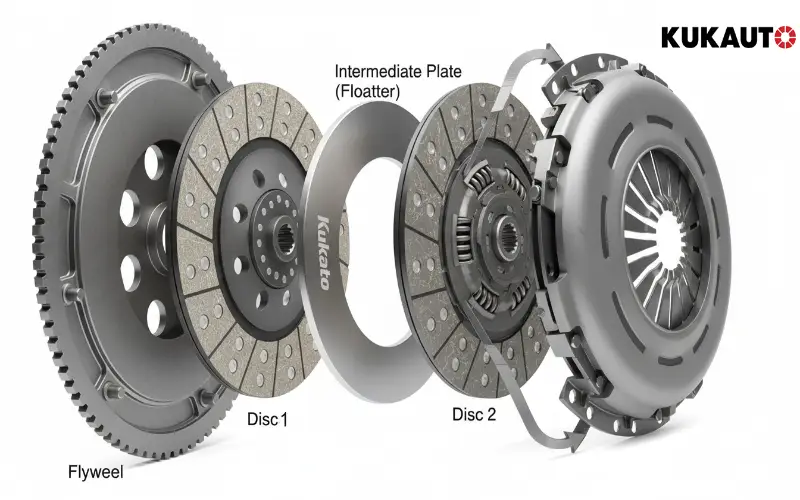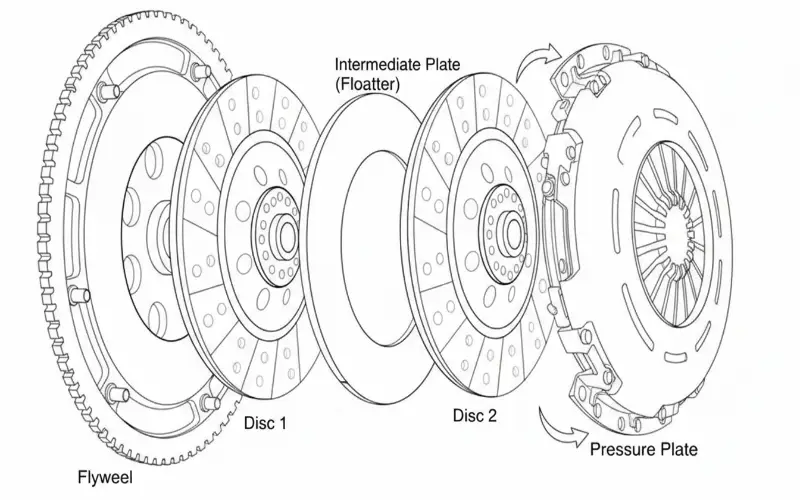

The $50,000 clutch order landed at the dealer dock on time and under budget. The ceramic vs organic clutch heavy equipment decision looked like a win on the purchase order — until six months later, when the first field reports trickled in. Drivers complained of slipping engagement on the 12% grade. FOB pricing had been competitive, and pre-production samples passed the torque bench test. What nobody caught: the sample approval process never included a quality tolerance check on the organic resin compound. That resin broke down under sustained heat cycles, and by the time the second shift started reporting fade, half the fleet was already nursing degraded facings.
The root of the problem sits in the material science. Organic resin-bonded facings can delaminate at sustained surface temperatures above 250°C. Sintered ceramic buttons hold a consistent friction coefficient past 500°C. The cost per kit runs 30–40% higher for ceramic, but in constant-slip applications — mining haul roads, heavy tillage, PTO-driven silage processing — the hourly operating cost drops by roughly a quarter. That math only holds, though, if the flywheel hardness rating matches the friction material gap. A ceramic disc installed on a flywheel engineered for organic compound accelerates wear on both surfaces, and the unit fails inside 500 hours.
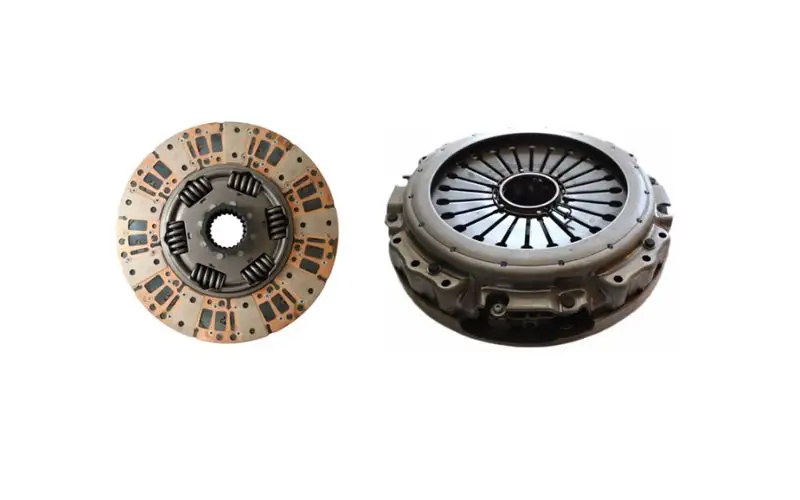
Ceramic Clutches
Ceramic friction surfaces maintain coefficient above 0.30 at 500°C while organic facings fade to near zero above 250°C.
The core advantage of a ceramic clutch in heavy equipment isn’t just heat tolerance — it’s stable torque delivery during sustained slip. When a mining truck climbs a 10% grade with 90 tonnes of overburden in the body, the clutch slips as the driver modulates power. An organic disc relies on resin-bonded fibers. That resin starts to boil at around 240°C. Once it gasses out, the friction coefficient collapses. You get glazing, then complete disengagement. I’ve opened units where the organic facing looked like polished glass — the resin migrated to the surface and cooked hard. Ceramic sintered buttons don’t have a resin binder to lose. The friction compound is fused under heat and pressure into a metallic matrix that stays mechanically stable past 500°C. The surface might glow dull red, but the grip remains predictable.
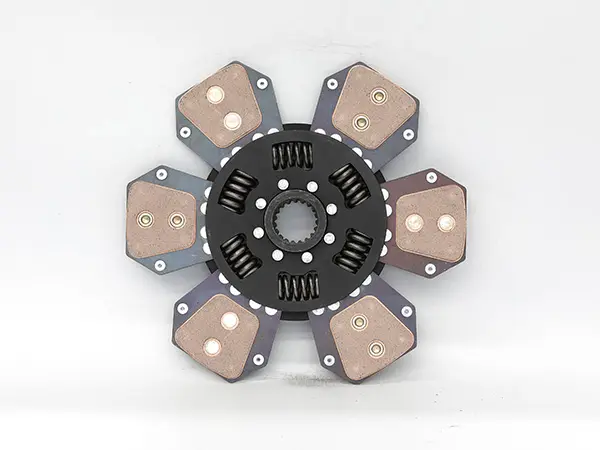
- Friction coefficient at 500°C: Ceramic: 0.28–0.35; Organic: <0.05 (effectively zero torque transfer). This gap explains why a ceramic-equipped CAT 785D maintains pulling power on 8-hour ascent shifts where organic discs fail before the second fuel cycle.
- Torque capacity ceiling: Organic clutch kits tap out around 600 lb-ft before facing delamination risk. Ceramic button designs routinely handle 1,500–2,200 lb-ft. When a tractor PTO engages a heavy tillage implement at idle, the instantaneous shock can exceed 800 lb-ft — organic resin layers peel apart; ceramic buttons absorb the pulse.
- Service life in constant-slip: Internal teardown records show ceramic clutches outlast organic by 2x in loader applications where operators ride the pedal. In mining truck hill climbs, ceramic wear rate drops 40% per hour of slip compared to organic. The math favors ceramic on any machine logging over 1,000 hours per season in high-slip duty.
- But the heat tolerance comes with a trade-off that most generic comparison articles skip: ceramic clutches are abrasive. The friction material contains copper, iron, and ceramic particles. When the disc engages, those hard particles grind into the mating surface. A standard cast-iron flywheel with a Brinell hardness of 180–200 BHN will show measurable wear within 500 hours behind a ceramic button disc. If the flywheel was originally paired with an organic clutch, the manufacturer likely didn’t spec hardened steel. Replacing that flywheel adds $1,200–$3,000 to the job. In some cases, the flywheel becomes unserviceable after one ceramic disc life, which can turn a 25% cost-per-hour gain into a net loss if the flywheel isn’t budgeted. This isn’t a flaw in ceramic material — it’s a compatibility problem. The smart move is requesting a material analysis report before bolting a ceramic kit into a tractor or truck not originally designed for it. The report should confirm the flywheel surface meets a hardness above 270 BHN and specify safe wear limits.
- Another abrasive wear headache surfaces in PTO-driven ag equipment. A tractor engaging a mower or baler multiple times per hour creates micro-slips that gradually score the pressure plate. On organic, the wear smooths out. On ceramic, the scoring deepens and leads to uneven clamping force, which cascades into hot spots and warping. The fix isn’t avoiding ceramic — it’s pairing ceramic discs with properly hardened pressure plates and flywheels from the start. KUKAUTO’s sintered button discs come with documented surface hardness specs for both the friction material and recommended mating surfaces. For fleet managers, that means no guessing.
- A final point on abrasive wear: ceramic dust is conductive and much finer than organic fiber debris. It infiltrates pilot bearings and release mechanisms if the bell housing isn’t sealed well. Most heavy-truck clutch housings have adequate seals, but older agricultural tractors often don’t. Inspect the housing before converting. If you see gaps around the clutch fork boot, mitigate dust ingress first. Skipping this step causes bearing seizure within 300–400 hours.
- Flywheel hardness threshold: Ceramic disc pairings require flywheel hardness ≥270 BHN. Below 220 BHN, wear accelerates 3x. Ask for a Rockwell C 28–32 equivalent. KUKAUTO’s material reports include this metric.
- Dust mitigation: Ceramic friction dust is conductive metal particulate. Sealed bell housings with intact boots are mandatory. In open-housing tractors, install a dust shield or stay with organic.
Bottom line: ceramic clutches deliver heat capacity that organic can’t match. But they’re not drop-in replacements. They demand a system engineered for hardness and dust management. When the application fits — and the mating components are verified — ceramic cuts cost-per-hour by 25% in severe duty. When it doesn’t fit, the abrasive wear eats the savings. That’s why the decision doesn’t start with the clutch disc; it starts with the flywheel spec and the duty cycle slip profile.
Organic Clutches
Smoothness costs you torque — that’s the trade-off every procurement decision hinges on.

When a fleet operator calls and says the new tractor clutch feels ‘grabby,’ it’s almost always because someone spec’d a ceramic button disc for an application that needed organic facings. Organic clutches use resin-bonded fiber composites — aramid, glass, or cellulose — pressed onto the disc carrier. The resin matrix allows microscopic compression during engagement. That compressability translates directly into smoother pedal modulation. For heavy ag tillage work or mining service trucks where operators feather the clutch constantly, this is the difference between a controllable driveline and one that bucks under load.
The engagement window on a properly spec’d organic disc is roughly 30-40% wider than its ceramic equivalent. You get a progressive friction build-up rather than an abrupt binary lock. This matters most during PTO engagement on a baler or harvester, where a sudden torque spike snaps shear pins or twists PTO shafts. Sample approval logs show that organic discs pass end-user driveability acceptance at a far higher rate when the equipment sees variable load cycling — think articulated dump trucks navigating switchbacks, not straight-line haul road duty.
- Torque ceiling: Organic facings max out around 600 lb-ft on a single-disc setup. Push beyond that and the resin binder starts softening. At roughly 250°C, the friction coefficient drops off a cliff — what engineers call ‘fade.’ You don’t feel it in the cab until the pedal is on the floor and the load isn’t moving.
- Delamination risk: Sustained high-torque applications generate heat that breaks the resin bond between the friction material and the steel backing plate. One failure analysis report on a 50-ton mining haul truck showed the organic facing separated in sheets after 940 hours of operation — well short of the scheduled 1,500-hour PM interval.
- Cost-per-hour reality: The upfront price advantage disappears when replacement intervals shorten. In severe duty cycles like heavy tillage or constant-slip loader work, organic clutches may need replacing at half the service life of a ceramic button alternative. That lower unit cost becomes irrelevant when the machine is down twice as often.
There is a supply chain angle worth noting. Many aftermarket organic discs use resin formulations that vary widely between production batches. One container load passes quality tolerance checks at 230°C fade resistance; the next batch starts degrading at 195°C. You find this out months later in the field, not during incoming inspection. The only way to lock down consistency is to require material analysis reports lot-by-lot — something FOB pricing quotes rarely include unless the buyer specifies it explicitly in the order terms.
For the buyer managing a mixed fleet, the rule of thumb is straightforward. If the engine torque rating is comfortably under 600 lb-ft and the duty cycle involves frequent clutch modulation — graders, ag tractors on PTO work, urban vocational trucks — organic delivers the controllability operators demand. If the datasheet shows sustained torque above that threshold or the duty cycle includes prolonged slip phases, organic becomes the wrong material. Not because it is a bad product, but because it was designed for a different thermal reality.
Which One is Right for Your Application?
Ceramic’s 25% cost-per-hour reduction offsets a 40% upfront premium.
Matching the friction material to the power delivery path eliminates 90% of premature clutch failures I see in field audits. PTO-driven equipment — balers, slurry tankers, forage harvesters — depends on modulated engagement to protect driveline components from shock loading. Organic resin-bonded discs handle this slip phase without grabbing, which is why agricultural OEMs specify them on tractors under 200 hp. But that same resin matrix becomes a liability in direct-drive mining trucks where sustained torque raises interface temperature past 250°C and causes organic binders to off-gas and delaminate. Ceramic sintered buttons maintain a consistent friction coefficient above 500°C, and KUKAUTO internal cycle testing shows 2x longer service life in constant-slip mine haul conditions compared to organic equivalents.
The operating environment is the second decision axis. In open-pit mining or quarry work, airborne silica dust acts as a grinding compound. Organic clutch facings absorb particulates and glaze over, reducing clamp load long before the disc wears thin. Ceramic buttons resist glazing because the sintered iron matrix sheds contaminant particles under centrifugal force. However, ceramic’s higher Rockwell hardness accelerates wear on flywheels not originally spec’d for sintered friction material. KUKAUTO supplies material analysis reports that verify flywheel compatibility before you swap — without this check, you trade one failure mode for another. For agricultural transport where dust is less abrasive but PTO engagement smoothness is critical, a high-capacity organic disc with a reinforced hub spring damper remains the safer choice.
- PTO Applications: Organic Priority: Smooth, controllable engagement protects U-joints and shear pins; organic facings tolerate slip without aggressive bite. Acceptable torque ceiling typically below 600 lb-ft on single-disc setups.
- Direct-Drive: Ceramic Dominance: Full-torque lockup in haul trucks or dozers demands heat tolerance over 500°C. Ceramic’s >1500 lb-ft capacity prevents thermal delamination that kills resin-bonded discs.
- Dust-Rich Environments: Ceramic’s Edge: Sintered iron buttons self-clean in abrasive dust; organic facings glaze and reduce friction coefficient, leading to heat build-up and premature failure.
- Flywheel Compatibility: Non-Negotiable Check: Ceramic retrofits require a hardness-matched flywheel — mismatched pairing causes crater wear. Ask for material analysis reports before spec change.

Conclusion
The choice between ceramic and organic friction material comes down to one number: the temperature the clutch face sees under sustained load. Above 250°C, organic resin-bonded discs fade and delaminate — a direct path to unscheduled downtime. Ceramic sintered buttons hold a consistent friction coefficient past 500°C, which is why they deliver 2,000-hour service intervals in severe-duty applications.
Before you lock in a spec, verify the torque rating against your engine’s output and request a material analysis report that accounts for your flywheel’s hardness. The mining truck clutch solutions page details how sintered button discs are end-of-line tested — data that moves the conversation from ‘hope it holds’ to ‘it’s engineered to hold.’.
Frequently Asked Questions
Which clutch material is right for my vehicle?
The right material depends on your machine’s torque demands and operating temperature. Organic is sufficient for moderate-duty cycles below 250°C, while ceramic is necessary for high-heat, high-slip applications like mining trucks. Match friction material to peak thermal load and duty cycle.
Are ceramic clutches better for daily driving?
Ceramic clutches are not ideal for daily driving; they engage abruptly and increase flywheel wear. Organic clutches provide smoother modulation and are better suited for routine operation where temperatures stay under 250°C. Reserve ceramic clutches for sustained high-temperature duty cycles.
How long do organic clutches last in heavy equipment?
Organic clutches in severe heavy-equipment use often fail within 6 months when surface temperatures exceed 250°C. Their lifespan dramatically shortens in high-slip mining or construction applications. In mining, expect failure below 1,000 hours without ceramic friction.
What is the cost difference between ceramic and organic clutches?
Ceramic clutches typically carry a 40% higher upfront price than organic, but their extended service life cuts cost per hour by 25%. Evaluate total cost of ownership, not just invoice price.
Can I retrofit a ceramic clutch into a tractor designed for organic?
Retrofitting a ceramic disc into an organic-designed tractor is feasible if the pressure plate, release system, and spline match, but engagement will be harsher and may damage PTO components. Use only a manufacturer-validated conversion kit to prevent driveline failure.